
ResearchGlobal Macro
Fiscal Support Today, Financing Questions Tomorrow
- Report or archive date
- Archive placement May 21, 2026
- Reading time
- 2 min read

Summary
A framework for evaluating public spending without reducing the debate to one debt ratio.
Government spending can support activity while simultaneously changing the economy’s future financing needs. The effects depend on what is purchased, how it is financed, and whether the economy has room to expand supply. A deficit is an accounting balance; understanding its economic meaning requires more detail.
Separate the purpose from the payment
A temporary transfer can help households maintain consumption. Infrastructure may add demand during construction and productive capacity later. An interest payment compensates an existing creditor without directly creating a new road or machine. These flows should not be treated as interchangeable simply because each appears in a public budget.

National accounting distinguishes government purchases from other fiscal flows. The BEA’s GDP framework is a useful starting point for that distinction. It prevents the mistaken assumption that every dollar of government expenditure enters GDP in the same way.
Consider an investment project financed with debt. If it reduces transportation costs for many years, the future tax base may benefit. If it is delayed, poorly used, or more expensive than expected, the debt remains while the expected benefit shrinks. The quality and timing of execution matter alongside the headline amount.

Follow the financing structure
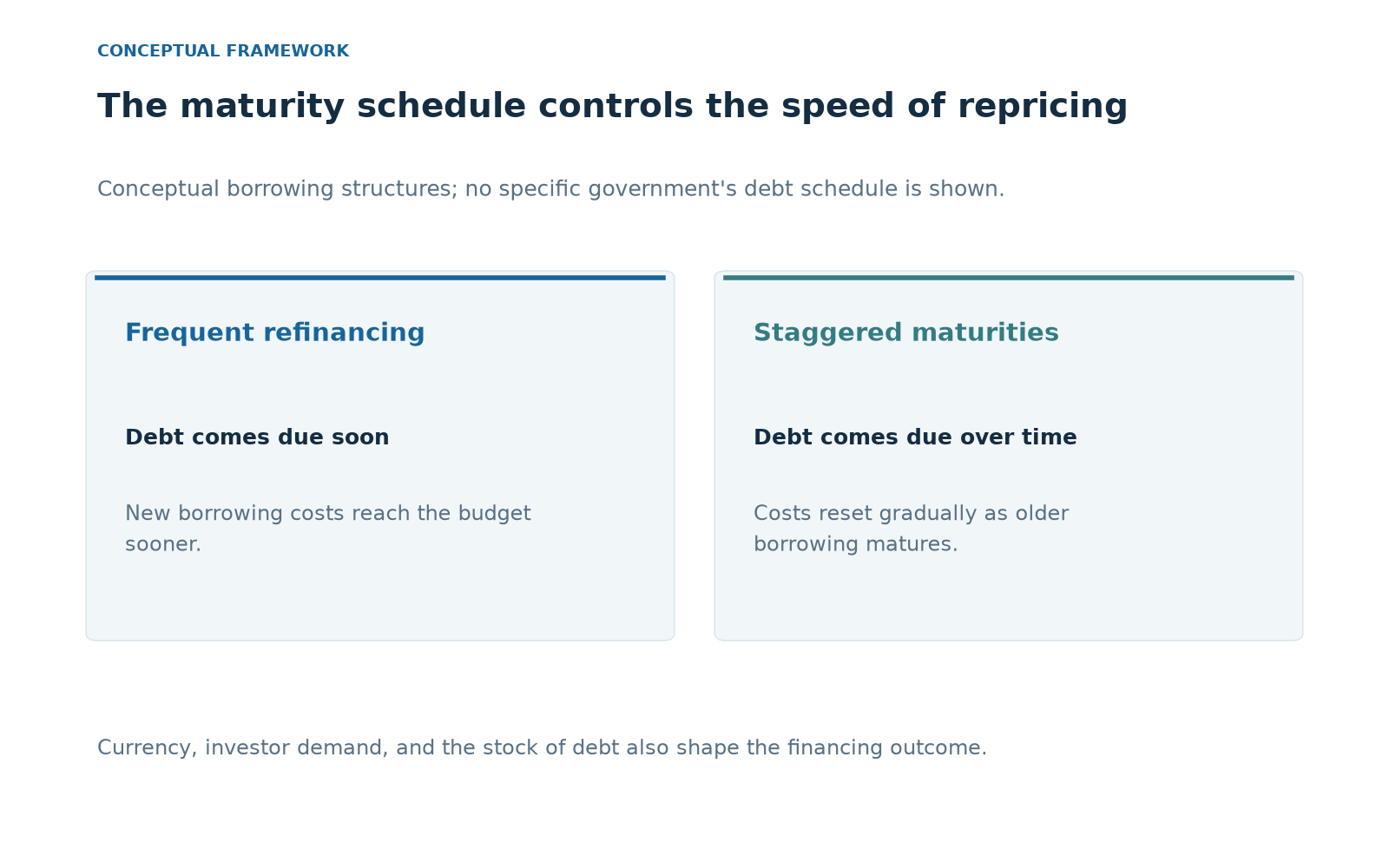
Debt service responds to both the stock of debt and the interest rates paid on it. A government with longer maturities may experience a gradual rise in financing costs as bonds mature. A borrower relying on frequent refinancing can feel changes more quickly. Currency denomination and the depth of the investor base also influence vulnerability.
The market implication is not a simple rule that larger deficits always produce higher yields. Growth expectations, inflation, central-bank policy, safe-asset demand, and bond supply interact. An analysis that attributes a yield move entirely to one fiscal announcement needs evidence separating those channels.
A disciplined conclusion
The useful questions are whether spending addresses a temporary shortfall or creates lasting capacity, whether revenue assumptions are credible, and how sensitive financing is to rates and growth. Fiscal support can be economically valuable and still require a sustainable funding plan. Both statements can be true without producing a precise forecast for the next bond auction.
Related research

ResearchGlobal Macro
When an Energy Shock Becomes a Broader Inflation Problem
Separating an immediate price jump from persistent economic effects.

ResearchGlobal Macro
A Stronger Currency Creates Winners and Losers
The same exchange-rate move can help a consumer, hurt an exporter, and change a portfolio return.

ResearchGlobal Macro
Reading a Labor Market That Sends Mixed Signals
Why payroll growth and unemployment do not always tell the same story.