
ResearchEquity Strategy
Global Revenue Does Not Eliminate Currency Risk
- Report or archive date
- Archive placement August 26, 2026
- Reading time
- 1 min read

Summary
Why an international business can still have concentrated financial exposure.
Selling in many countries can diversify demand while creating a complicated currency profile. The relevant question is not how many flags appear on a company’s presentation. It is how revenues, expenses, assets, and debts respond when exchange rates change.
Currency Translation vs. Transaction Exposure
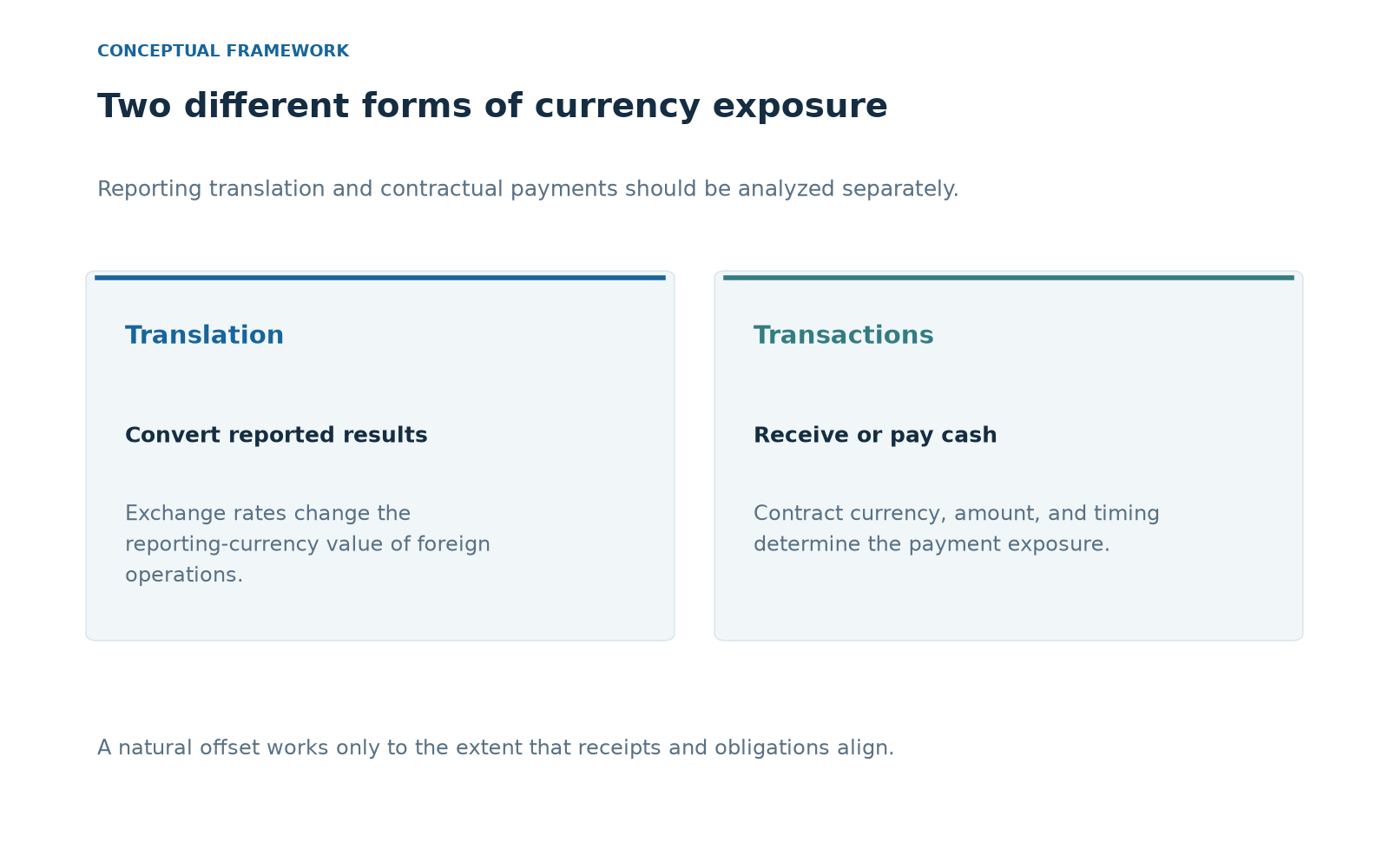
Translation changes the reporting-currency value of overseas results. Transaction exposure affects actual contractual receipts or payments. A company can experience both, and they need not move together. Financial-statement notes and management discussion are the appropriate starting points for understanding those exposures.

Consider a U.S. business that earns revenue and pays most costs in the same foreign currency. A stronger dollar may reduce reported revenue and profit without dramatically changing local operating margins. A different business that exports from a dollar cost base may face a more direct competitiveness problem.
Debt introduces another channel. Borrowing in the same currency as recurring income can create a natural offset, but only if the amount and timing are aligned. A large maturity arriving before cash receipts can still produce a funding problem.
Understanding Growth Measured at Constant Exchange Rates
Constant-currency growth can help isolate operating changes from exchange-rate movements. It is an analytical adjustment, not cash that shareholders actually receive. The calculation should be explained consistently and read alongside reported results.

Hedging may reduce short-term variability while leaving longer-term competitive exposure intact. Contracts expire, forecasts change, and a company may hedge only a portion of expected receipts. A stable near-term earnings result does not establish that currency risk has disappeared.
Connect the exposure to valuation
The equity question is whether exchange-rate changes alter sustainable cash generation or mainly affect presentation. That requires attention to customer pricing, competitor costs, and financing. A globally diversified revenue base can be valuable, but it is not a substitute for examining the actual currency mismatch. A clear research note identifies the largest exposures, the available offsets, and the limits of what public disclosures reveal.
Related research

ResearchEquity Strategy
Buybacks Change the Share Count, Not the Laws of Economics
Evaluating repurchases through price, funding, and the uses of cash they displace.

ResearchEquity Strategy
The Cash-Flow Test for a Capital-Spending Boom
Investment is valuable when future cash generation justifies today’s commitment.

ResearchEquity Strategy
Index Concentration Is a Portfolio Exposure, Not a Market Verdict
A rising index can depend on a narrow set of earnings drivers.