
ResearchEquity Strategy
Buybacks Change the Share Count, Not the Laws of Economics
- Report or archive date
- Archive placement July 16, 2026
- Reading time
- 1 min read

Summary
Evaluating repurchases through price, funding, and the uses of cash they displace.
A share repurchase can increase earnings per share without increasing total earnings. It can also return excess capital efficiently or weaken a balance sheet. The economic result depends on the price paid, the funding source, and the alternatives available to the business.
Begin with the arithmetic
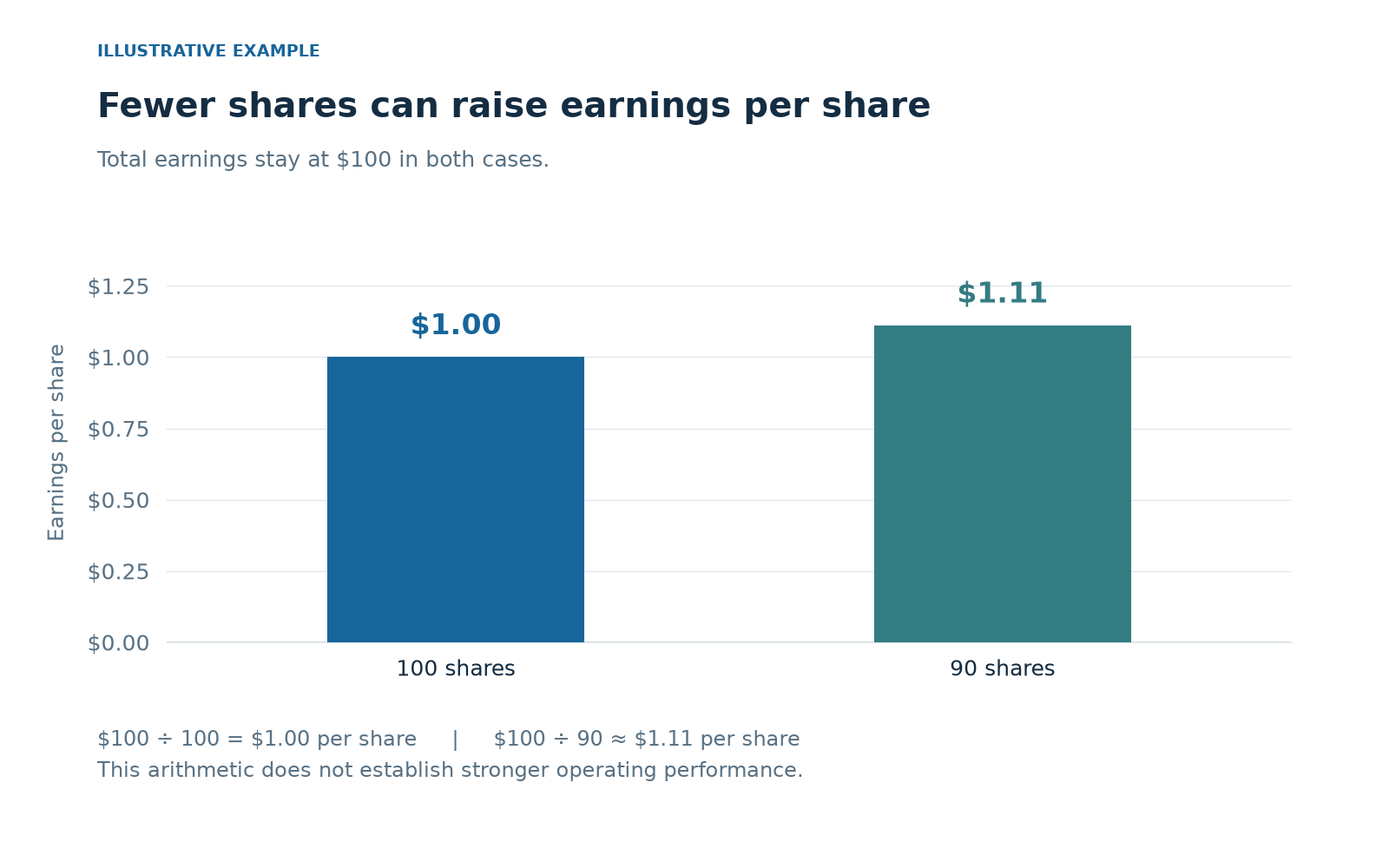
Suppose a company earns $100 and has 100 shares. Earnings per share are $1. If earnings remain unchanged and the share count falls to 90, earnings per share rise to about $1.11. The increase is real arithmetic, but it does not demonstrate stronger customer demand or improved operating margins.
The cash flow statement and shareholders’ equity disclosures help distinguish operating cash generation from financing actions. An analyst should also examine dilution from employee compensation or new issuance. Gross repurchases can look large while the net share count barely changes.
Consider what the cash could do
Repurchases compete with investment, debt repayment, acquisitions, dividends, and liquidity reserves. A company with limited attractive reinvestment opportunities may rationally return cash. Another may sacrifice projects with strong expected returns to support a short-term per-share target.

Financing matters as well. A debt-funded repurchase can increase per-share earnings when borrowing costs are low relative to the earnings yield, but it also leaves fewer resources available in a downturn. The apparent improvement should be evaluated after interest costs and the increased risk of refinancing.

Price is central. Buying shares below a defensible estimate of value can benefit remaining owners; paying too much can transfer value to selling shareholders. Since intrinsic value is uncertain, management’s process and consistency deserve scrutiny.
Judge the full capital-allocation record
A useful assessment asks whether repurchases expand when the business has surplus cash and attractive pricing, or merely when earnings are strong and shares are expensive. It also asks whether management protects investment and financial flexibility. Buybacks are a tool. Their presence does not establish shareholder discipline, and their absence does not prove that capital is being wasted.
Related research

ResearchEquity Strategy
Index Concentration Is a Portfolio Exposure, Not a Market Verdict
A rising index can depend on a narrow set of earnings drivers.

ResearchEquity Strategy
Global Revenue Does Not Eliminate Currency Risk
Why an international business can still have concentrated financial exposure.

ResearchEquity Strategy
Pricing Power Must Survive a Customer’s Response
Higher prices improve a business only if volume, retention, and costs cooperate.