
ResearchEquity Strategy
Index Concentration Is a Portfolio Exposure, Not a Market Verdict
- Report or archive date
- Archive placement June 4, 2026
- Reading time
- 1 min read

Summary
A rising index can depend on a narrow set of earnings drivers.
A broad stock index can contain hundreds of companies while depending heavily on a small number of large positions. That is a property of its weighting system. It is neither automatic evidence of a bubble nor a guarantee that the index offers balanced exposure to the economy.
Check the Underlying Holdings for Overlapping Exposures
Diversification depends on the underlying holdings and their economic drivers, not simply on the number of funds an investor owns. Three funds with different names can hold many of the same companies. A portfolio may therefore concentrate risk even as its list of positions grows.
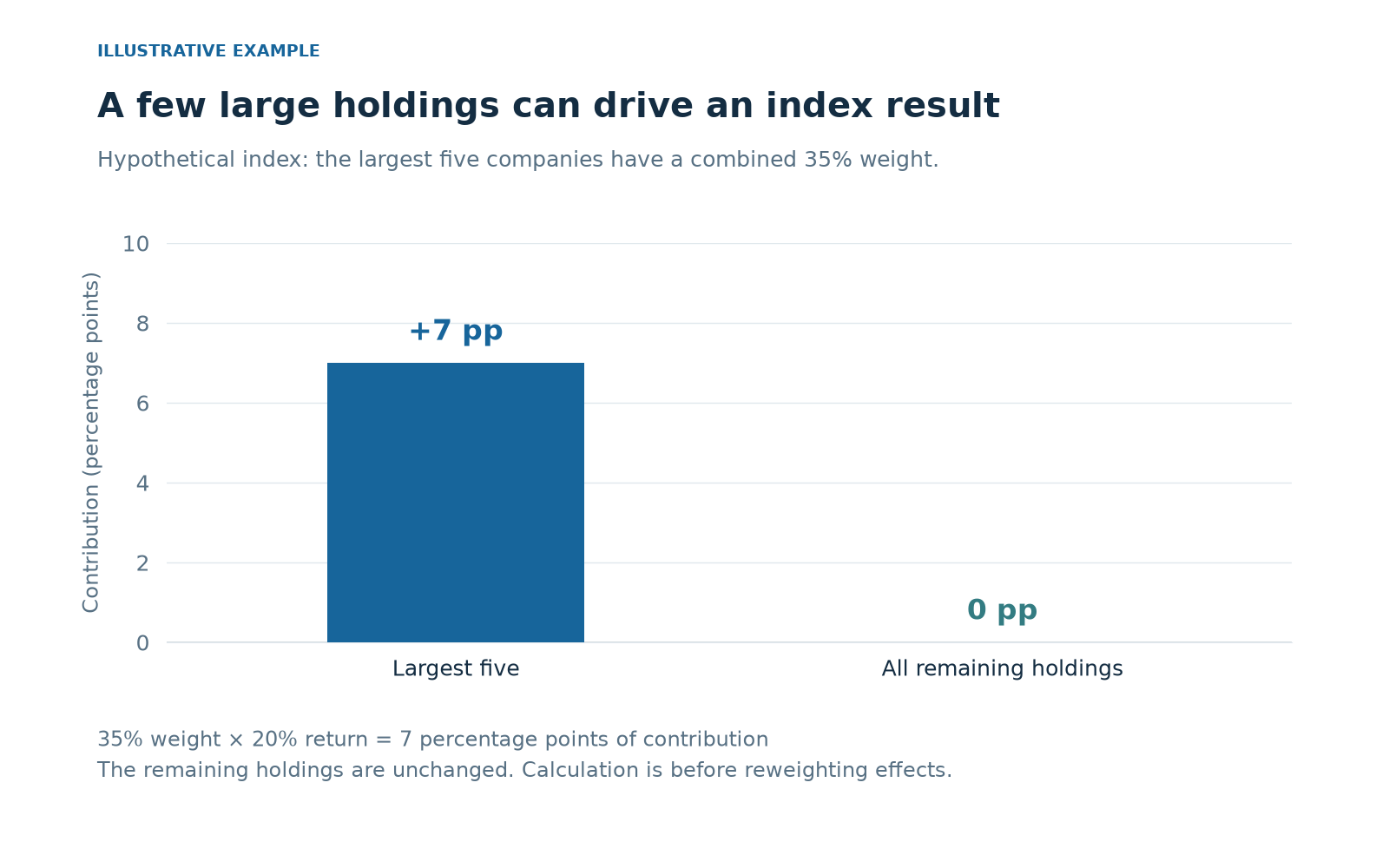
In an index, the largest five companies account for 35% of value. If those companies gain 20% while the remainder is unchanged, their contribution is roughly seven percentage points before reweighting effects. The index’s strong result would say little about the experience of the typical constituent.
That arithmetic does not imply that the largest companies are overvalued. Their weight may reflect substantial profits, strong balance sheets, or investor expectations of durable growth. The question is how dependent the portfolio has become on those expectations.

Compare exposures, not just counts
An equal-weighted comparison changes more than concentration. It can introduce greater exposure to smaller firms, different sectors, and more frequent rebalancing. Any performance difference should be interpreted in light of those changes. It is not a pure test of whether large companies are expensive.

The same principle applies to geographic diversification. Companies listed in different countries can depend on the same customer base, supply chain, or financing conditions. Conversely, companies in one country can have very different business risks.
Make the risk visible
A practical review examines issuer weights, sector weights, revenue sources, and sensitivity to shared assumptions. Stress tests can then ask what happens if a dominant earnings theme disappoints. The purpose is to understand the consequences of concentration before a shock, not to infer a market turning point from concentration alone. A concentrated portfolio can succeed; it should still be recognized as concentrated.
Related research

ResearchEquity Strategy
Pricing Power Must Survive a Customer’s Response
Higher prices improve a business only if volume, retention, and costs cooperate.

ResearchEquity Strategy
Buybacks Change the Share Count, Not the Laws of Economics
Evaluating repurchases through price, funding, and the uses of cash they displace.

ResearchEquity Strategy
A Low Price-to-Earnings Ratio Can Be Expensive
Valuation requires a view of earnings durability, not just a ranking of multiples.