
ResearchFixed Income
Matching Bond Cash Flows to a Spending Need
- Report or archive date
- Archive placement November 9, 2026
- Reading time
- 13 min read

Summary
The right bond horizon depends on the payment the money must support. Three cases distinguish a fixed invoice, an inflation-sensitive purchase, and an uncertain payment date, showing why maturity, duration, and available cash solve different problems.
Start with the payment instead of the yield
A higher yield can attract attention before the purpose of the money has been defined. Yet a bond that looks appealing on a yield screen may be poorly suited to a payment due before it matures. A security with a lower quoted yield can serve a known obligation more reliably if its cash arrives in the required amount and on the required date.
Cash-flow matching begins with the obligation. Identify its currency, amount, payment date, and uncertainty. Then examine assets whose payments can meet it. The objective is not simply to maximize the portfolio's stand-alone return; it is to make the resources available when the obligation must be satisfied.
That approach changes the meaning of risk. A market-value decline may be tolerable if matched payments will arrive as promised and no sale is needed. A seemingly stable investment may create a problem if its proceeds arrive too late or must be reinvested at an unknown rate before the obligation comes due.
First match payments to funding needs without taxes, fees, defaults, or minimum denominations. Then check whether those constraints change the match.
Case one: a museum has two fixed invoices
A museum owes $50,000 exactly one year from now and $120,000 exactly three years from now for completed phases of a contracted renovation. Assume the invoice amounts are fixed in dollars and cannot be accelerated. The museum wants to fund both without depending on a future bond sale.
Suppose a default-free zero-coupon payment of $50,000 in one year can be purchased at a 4% annually compounded spot rate. Its current cost is $50,000 divided by 1.04, approximately $48,076.92. A separate $120,000 payment in three years, discounted at a 4.5% annual spot rate, costs approximately $105,155.59.
At the displayed cent-rounded purchase amounts, the combined cash outlay is $153,232.51. Each payment matches one invoice. The arrangement does not rely on reinvesting the first maturity to fund the second obligation, because the three-year obligation has its own dedicated payment.
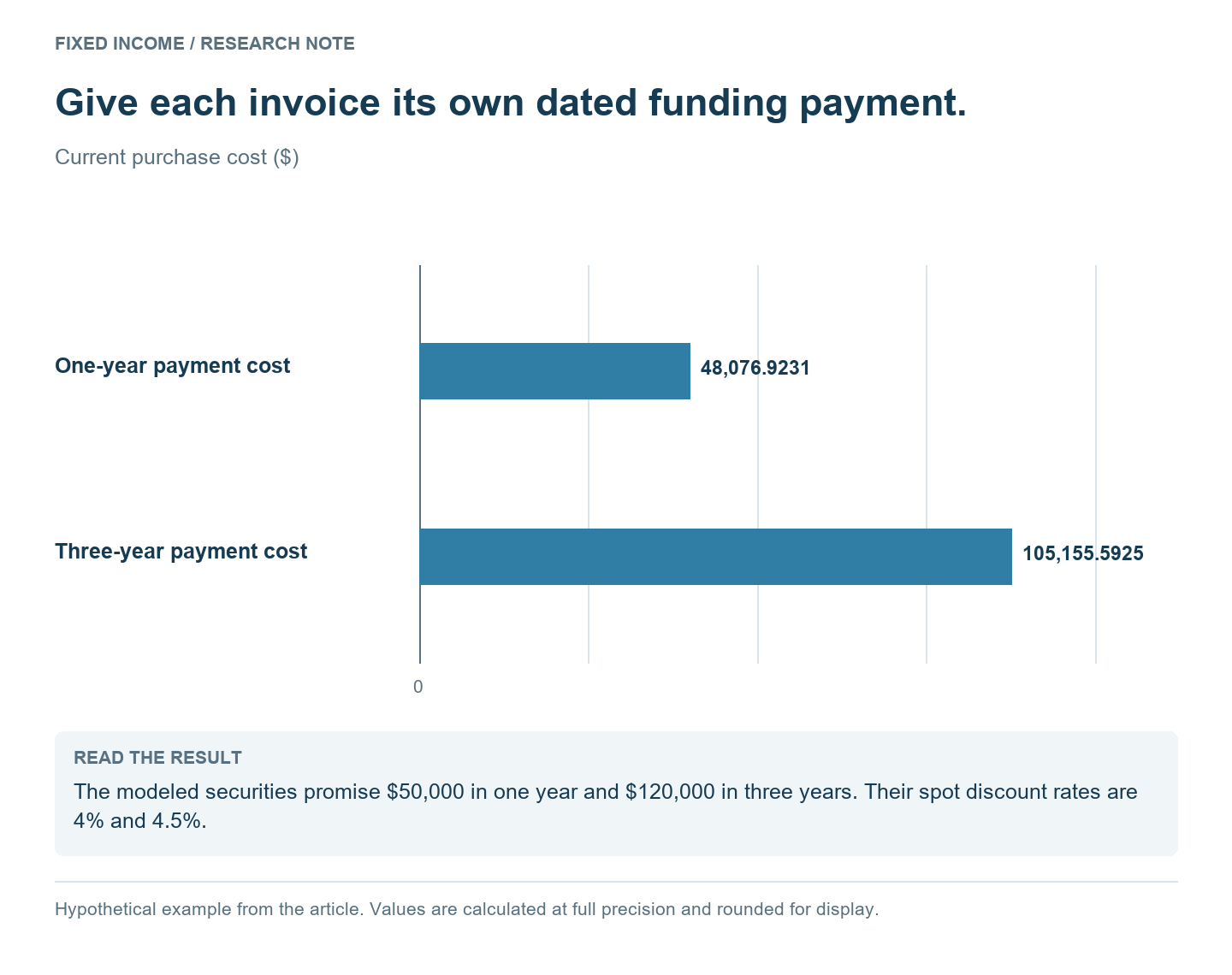
In this simplified setting, changes in market yields alter the interim values of the securities but not their promised dollar payments. If the museum retains the positions and receives those payments as assumed, the invoices can be paid without selling into the changed market. The relevant success condition is the arrival of $50,000 and $120,000 on their respective dates.
To build the portfolio, check the maturity, executable price, and settlement date of each available security. Match the cash that will be available on each payment date with the amount due.
Coupon bonds require a payment map
A coupon bond provides several payments, not only principal at maturity. Those coupons can help fund intermediate obligations, but they must be placed on the calendar individually. Treating the whole bond as a single maturity payment can overlook useful cash or count the same payment toward more than one invoice.
For the museum, a coupon arriving before the first invoice may cover part of that payment. A coupon arriving after the invoice cannot help unless another source bridges the interval. Any coupon received earlier than needed introduces a cash-management or reinvestment question for the period between receipt and use.
Zero-coupon instruments make the example simple because each delivers one scheduled amount. Treasury STRIPS illustrate how individual principal and interest payments can be separated into securities in actual markets. Their availability, price, account arrangements, and other terms still need to be checked for a particular implementation.
A useful matching worksheet lists every asset receipt and every obligation by date, then shows the remaining cash balance after each event. A positive year-end total is not sufficient if the balance becomes negative earlier. The sequence of cash availability, rather than only the aggregate amount, determines whether the plan works.
Case two: a laboratory faces an uncertain equipment price
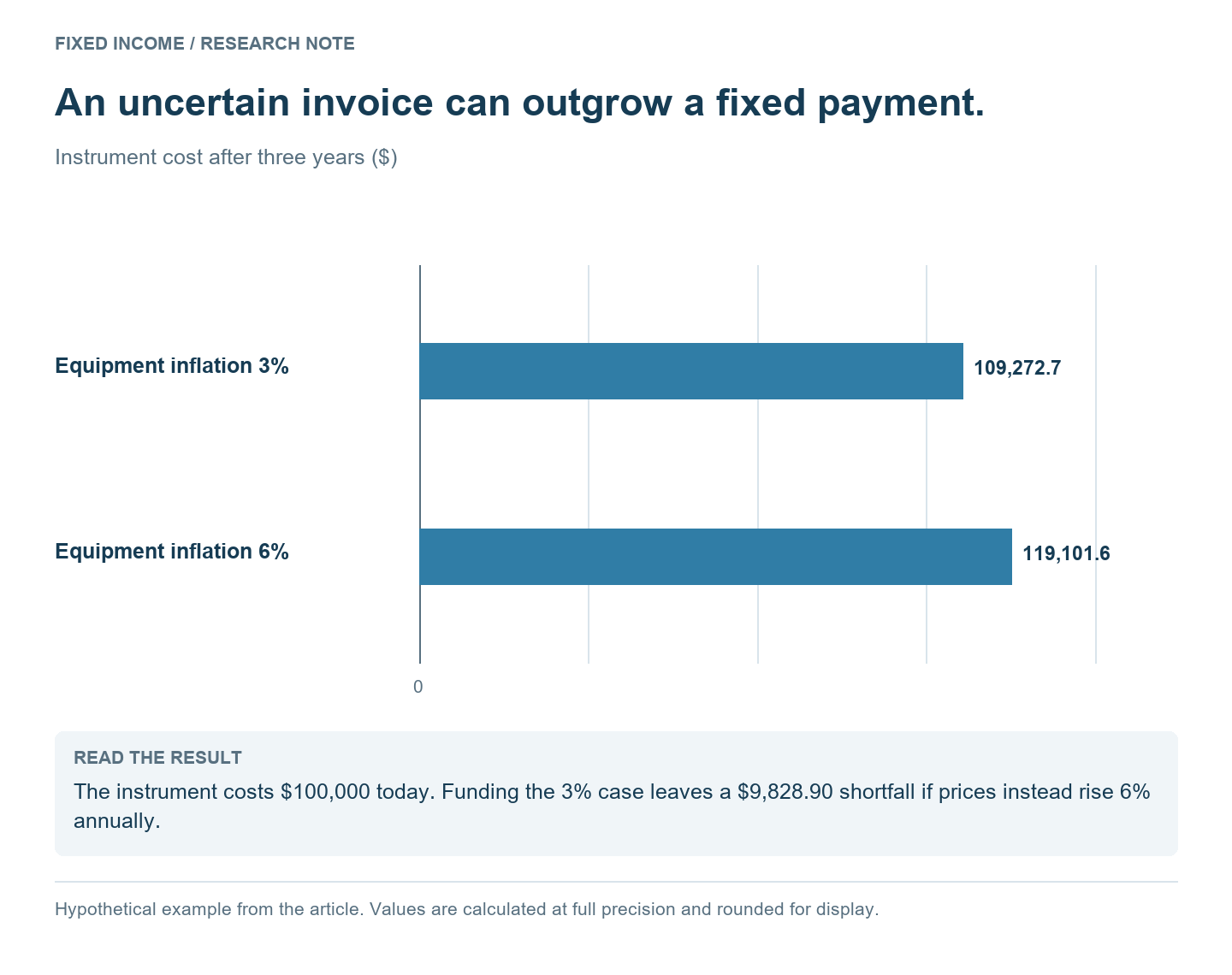
A research laboratory expects to replace a specialized instrument in three years. Its current estimated cost is $100,000, but the future purchase price is not contractually fixed. If equipment prices rise 3% each year, the future cost becomes $109,272.70. At 6% annual increases, the cost becomes $119,101.60.
A nominal payment that exactly funds the first scenario leaves a $9,828.90 shortfall in the second. The bond can make every promised payment and still fail to meet the laboratory's need. The problem is uncertainty about the obligation's amount, not default by the bond issuer.
Inflation-linked assets can address some purchasing-power exposure, but the relevant index must be examined. For a simplified example, assume a future resource begins at $100,000 and grows exactly with a broad price index that rises 2% annually. After three years it equals $106,120.80. If the specialized equipment instead rises 6% annually, the gap is $12,980.80.
This index-linked resource is a calculation, not the quoted cost or payoff of an available security. Its purpose is to isolate basis risk: the laboratory's specific spending price may behave differently from the broad index used by an asset. Matching inflation in general is not automatically the same as matching the price of one specialized purchase.
The laboratory may need to update its estimate using supplier quotations, delivery requirements, and changes in specification. A more powerful instrument, a different configuration, or an installation expense can change the obligation independently of inflation. A financial hedge cannot cover a spending requirement that has not been defined consistently.
Understand what inflation protection actually promises
Treasury Inflation-Protected Securities adjust principal with the specified consumer price index, and their fixed coupon rate is applied to the adjusted principal. Their market prices can still change when real yields change. The maturity protection also refers to contractual principal terms, not a promise to reimburse every secondary-market purchase premium.
For a spending plan, payment dates and indexation timing matter alongside the inflation adjustment. A bond that matures after the equipment must be purchased requires an early sale or bridge financing. A broad inflation index can lag the spending price or follow a different basket. Those differences remain relevant even when the instrument performs exactly as designed.
The laboratory's analysis can therefore distinguish a baseline funding amount from a reserve for uncertainty. One scenario might assume ordinary equipment-price growth; another might include a larger cost increase or earlier delivery. The reserve should correspond to plausible uncertainty in the obligation rather than a claim that one inflation-linked security removes every risk.
If the supplier offers a binding fixed-price contract, the nature of the liability changes. The laboratory would then need to examine the contract's conditions, supplier performance, cancellation terms, and payment dates. Some price uncertainty may shift into counterparty or contractual risk rather than simply disappear.
Case three: a foundation does not know the exact grant date
A community foundation expects to make a fixed $40,000 grant in two years, but the project could become ready after one year or be delayed until year three. Suppose the foundation initially buys a two-year zero-coupon payment of $40,000 at a 4% annual spot rate. Its cost is approximately $36,982.25.
If the grant remains due at the two-year date and the security pays as promised, the amount and date match. If the project accelerates to year one, however, the foundation must raise cash before the security matures. Assume its remaining one-year yield at that point is 6%. Its sale value would be approximately $37,735.85.
The foundation would be short approximately $2,264.15 against the $40,000 grant. Notice that the security's sale value is above its original purchase cost. A positive investment gain can coexist with a funding shortfall when the obligation arrives earlier than the cash flow intended to meet it.
If the grant is delayed to year three instead, the security pays $40,000 in year two. The foundation then needs to preserve or reinvest that cash for another year. At an assumed 2% return over that interval, it would have $40,800; at zero return, it would retain $40,000 before costs. Those outcomes address the fixed nominal grant, not any additional inflation-sensitive expenses.
The uncertainty is in timing, so the response should address timing. An earlier maturity, a liquid reserve, staged grant commitments, or another credible source of bridge cash can change the exposure. Choosing among them requires understanding how early payment could be requested and how much flexibility the foundation actually has.
Funding the earliest date can cost more initially
For comparison, suppose the foundation can buy a one-year zero-coupon payment of $40,000 at a 4% annual yield. Its initial cost is approximately $38,461.54, about $1,479.29 more than the two-year payment in the earlier example. The higher initial funding amount buys earlier cash availability under the stated rates.
If the grant arrives on the earliest possible date, that one-year payment matches it. If the grant is delayed, the foundation must preserve the proceeds until needed. The shorter instrument removes one early-sale dependency while introducing a period of cash management after maturity. It does not maximize the initial quoted yield or settle every reinvestment question.
This comparison is particularly useful when a plan appears underfunded only because it assumes the most convenient payment date. The obligation should be tested at the earliest credible date, not merely at its most likely date. If the organization cannot fund that outcome, the remaining uncertainty should be visible in the plan.
The choice can also depend on whether the date is genuinely outside the organization's control. A grant agreement allowing scheduled installments may create a more predictable liability than a promise to pay whenever a project becomes ready. Contract design and portfolio design can interact, although neither should be assumed adjustable after commitments have been made.
Duration matching is a different kind of protection
Cash-flow matching arranges payments against obligations. Duration matching instead aligns sensitivity of asset and liability values to a specified change in interest rates. It can be useful when exact matching is impractical, but the two methods should not be described as equivalent.
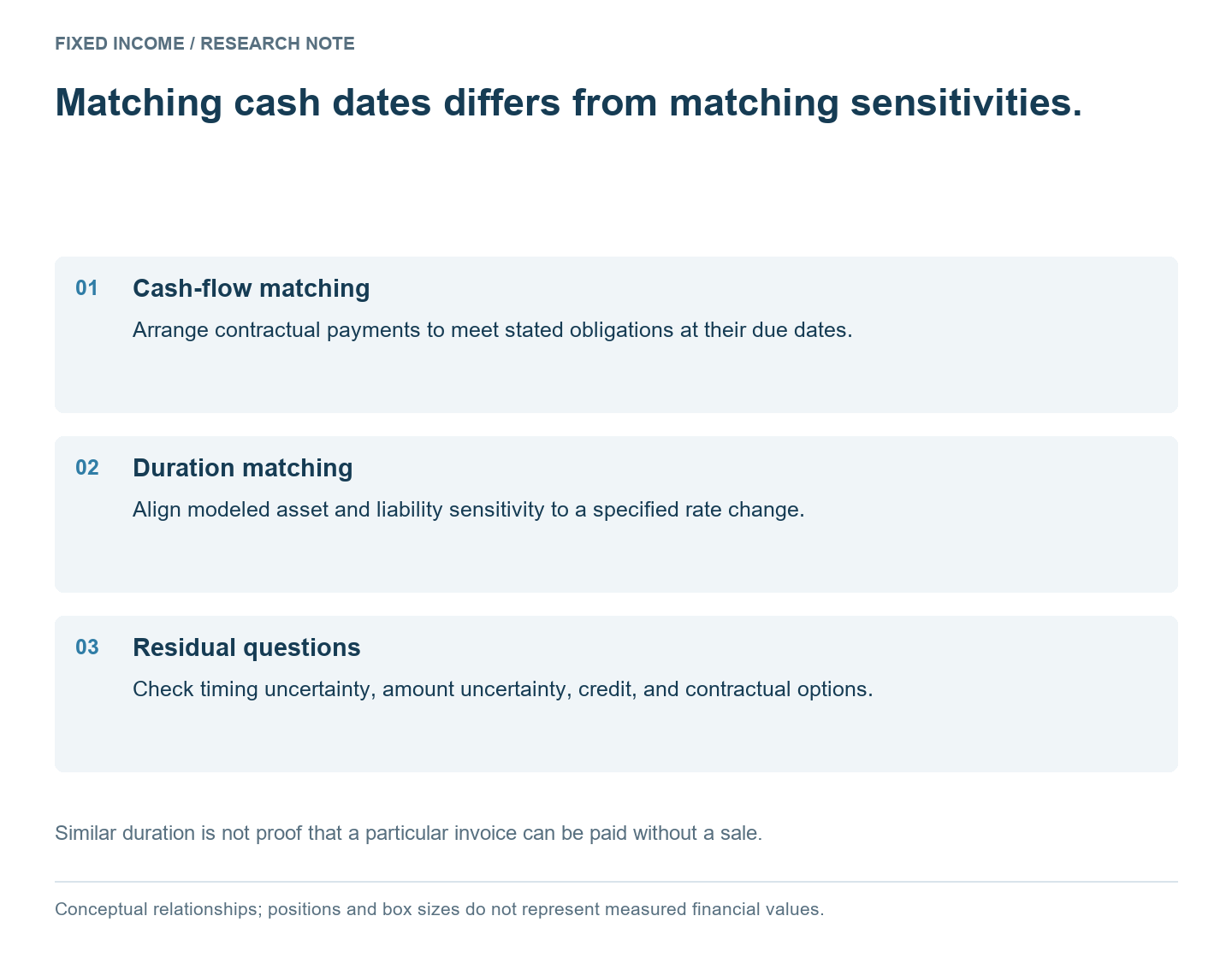
Two portfolios can have the same total duration while concentrating payments at different dates. If the curve changes unevenly across maturities, their values can respond differently. Likewise, an asset portfolio and a liability can share an initial sensitivity to a small parallel shift while differing in their responses to larger or nonparallel changes.
An immunization framework therefore needs assumptions about valuation, yield changes, cash-flow stability, and rebalancing. Matching one reported duration number without checking market values, convexity, and the relevant curve does not establish complete protection. Changes in time and yields can also alter the original match.
For the museum's fixed invoices, exact payment matches make the logic unusually direct. For the laboratory's uncertain equipment price or the foundation's shifting date, the liability itself changes across scenarios. A duration match to one estimated liability is only as relevant as that estimate and the assumptions surrounding it.
Evaluate assets and obligations together
An organization may see its bond portfolio gain value when yields fall. If the present value of its future obligations rises by a similar amount under the same valuation basis, its funding position may not improve nearly as much as the asset gain suggests. The asset-only return and the change in surplus answer different questions.
Conversely, a decline in asset market value does not necessarily impair a perfectly matched nominal payment plan. If the dedicated asset cash flows and fixed obligations remain aligned, both sides can change in present value without changing the scheduled ability to pay. That conclusion depends on payment certainty, retention of the assets, and the absence of other claims on the cash.
The discount rate used to value the liability should not be chosen merely to make the funding ratio look attractive. A higher discount rate mechanically lowers present value, but it does not reduce the dollar payment due. Economic valuation, accounting rules, and cash funding need to be distinguished rather than combined opportunistically.
A useful report can show both views: the modeled present-value surplus or shortfall and the actual dated cash coverage. The first helps analyze sensitivity and funding cost. The second reveals whether the organization can meet its payments without relying on unplanned sales or borrowing.
Implementation introduces gaps the simple examples omit
Real securities may not mature on the exact invoice date. A maturity slightly before the obligation creates a short cash-holding interval; a maturity afterward creates a funding gap. The two mismatches are not equivalent. The gap after the payment deadline requires another resource, while earlier cash needs a suitable place to remain available.
Minimum purchase sizes can also prevent an exact dollar match. A plan may need to buy slightly more than the modeled amount or combine securities and cash. Transaction costs, accrued interest, and account-level charges affect the initial funding requirement. A mathematically matched face amount is not necessarily the same as an affordable executable purchase.
Payment delivery deserves attention. A security's contractual payment date and the date proceeds are available in the relevant operating account may differ operationally. A plan should allow for the actual custody and transfer process rather than assume that a maturity and an invoice on the same date always settle in the desired order.
Tax or other mandatory cash outflows can matter even before a zero-coupon instrument pays cash. Their treatment depends on the instrument and account. A practical plan includes the applicable cash requirements rather than treating the security's payment schedule as the only cash flow the organization will face.
Keep credit and optionality visible
Matching promised corporate coupons to fixed invoices does not eliminate the possibility that the coupons are delayed or unpaid. An exact calendar match can still contain concentrated credit exposure. The reliability of the assets supporting a critical payment is therefore part of the matching problem, not a separate afterthought.
Callable bonds can return principal earlier than expected. Mortgage-related payments can change as borrowers prepay. Those features can alter the timing of resources available for the obligation. A higher yield on an instrument with uncertain payment timing cannot be treated as a free improvement to a schedule that assumed fixed dates.
Currency is another matching dimension. A bond paying dollars does not exactly fund a fixed euro invoice unless the currency conversion is addressed. A hedge can reduce a specified mismatch, but its amount, date, cash requirements, and counterparty terms become additional parts of the plan.
The same discipline applies to backup facilities. A line of credit that expires before the obligation or becomes unavailable under the relevant stress is not a reliable substitute for matched cash. Each proposed resource needs to survive the scenario in which it would be called upon.
Review the obligation when circumstances change
A dedicated payment can lose its usefulness if another commitment is placed ahead of it. Suppose the museum later pledges the security that will pay $50,000 to support borrowing used for a different project. Assume $10,000 of that borrowing must be repaid from the maturity proceeds, ignoring interest for this narrow example. Only $40,000 remains for the original $50,000 invoice.
The security has not failed, and its payment date has not changed. The shortfall arises because the same resource was assigned to two uses. The original cash-flow match no longer describes the museum's net available funds. A matching plan therefore needs to track restrictions and competing claims, not simply ownership of the asset.
Similar double counting can occur without formal borrowing. An organization might include the same cash reserve in both a renovation budget and a separate emergency plan. Each plan appears funded when viewed alone, but simultaneous demands reveal that the reserve cannot satisfy both. The relevant test is the combined cash schedule under the scenario being considered.
Reserves are most useful when their purpose is explicit. Distinguish money committed to fixed payments from money available for timing variation, price uncertainty, and genuinely unexpected needs. Those categories can be revisited as circumstances change, but moving funds between them should be recorded as a change in the plan rather than assumed harmless.
This discipline is particularly important when markets perform well. A rise in the value of a dedicated asset can look like available profit, yet selling part of it may reduce the future payment below the amount required. Evaluate the remaining cash-flow coverage before treating an interim market gain as spendable surplus.
The three organizations should update their plans for different reasons. The museum needs to track contract amendments and whether payment milestones remain fixed. The laboratory needs updated equipment specifications and price estimates. The foundation needs information about the project's readiness and the permissible timing of the grant.
Changes in asset prices alone are not the only trigger for review. A new spending commitment, a revised currency, or an accelerated date can break a previously sensible match without any unusual market movement. Conversely, a market move may leave a dedicated fixed-payment schedule intact.
The review should preserve the original assumptions and record what changed. That makes it possible to distinguish a modeling error from a new obligation or a realized adverse scenario. Rewriting the original plan after the outcome obscures the lesson and weakens the next decision.
Cash-flow matching is most useful when it brings the spending need into focus. Ask how much is owed, when it can be demanded, what changes its purchasing-power requirement, and which asset payments can actually reach it. Yield remains relevant to the cost of funding that plan, but the obligation determines what the plan must accomplish.
Related research

ResearchFixed Income
What a Policy Hold Means for a Refinancing Calendar
An unchanged policy rate does not preserve the borrowing cost of debt issued years earlier. A debt maturity schedule shows how old coupons, new market terms, fees, and the timing of available cash determine the refinancing burden.

ResearchFixed Income
Income, Price Changes, and Reinvestment Make Up Total Return
Coupon income is only one part of a bond investment's result. A complete cash-flow reconciliation distinguishes price changes, reinvestment earnings, costs, and outside contributions—and explains why an initial yield and a realized compound return can differ.

ResearchFixed Income
Liquidity Can Disappear Before a Bond Defaults
A bond can keep paying while becoming difficult to sell at its displayed value. An original execution example separates the quoted spread, available transaction size, price impact, and settlement timing that determine how much cash a holder can actually raise.