
ResearchFixed Income
What a Policy Hold Means for a Refinancing Calendar
- Report or archive date
- Archive placement October 29, 2026
- Reading time
- 13 min read

Summary
An unchanged policy rate does not preserve the borrowing cost of debt issued years earlier. A debt maturity schedule shows how old coupons, new market terms, fees, and the timing of available cash determine the refinancing burden.
The policy setting can pause while financing costs keep changing
On October 28, 2026, the Federal Open Market Committee maintained its federal funds target range at 3.75%–4.00%. For a company approaching a debt maturity, that decision is relevant background. It is not a promise that replacing an old bond will cost the same as servicing it did before.
A fixed coupon reflects the terms established when the debt was issued. Refinancing reflects the terms available when new lenders commit funds. The difference can remain substantial even if the central bank makes no change at the latest meeting. Benchmark yields, credit spreads, transaction costs, and the company's own financial condition can all differ from their earlier levels.
The practical unit of analysis is therefore the maturity calendar. Which obligation comes due, how much principal must be repaid, what cash will be available by that date, and what financing is realistically accessible? A policy headline cannot answer those questions without a bridge to the issuer's specific cash flows.
Read the old debt schedule before applying a new rate
Assume a company has $300 million of fixed-rate debt in three tranches. The first is $60 million with a 3% coupon, maturing in June 2027. The second is $90 million with a 4% coupon, maturing in June 2029. The third is $150 million with a 5% coupon, maturing in June 2032. For clarity, annual coupon costs are calculated on unchanged principal without amortization or embedded options.
The annual interest costs are $1.8 million, $3.6 million, and $7.5 million, respectively. Total annual interest is $12.9 million, equivalent to a 4.3% weighted coupon on the $300 million debt balance. That average describes existing contractual interest, not the rate available for a new borrowing.
Only the first $60 million tranche reaches maturity in the initial refinancing exercise. Applying a new market rate immediately to all $300 million would overstate the near-term change under these fixed-rate terms. Ignoring the first maturity because most debt is longer dated would make the opposite mistake.
The schedule should also identify amortization, puts, calls, covenants, and any conditions that could accelerate repayment. A stated final maturity is not the whole calendar if principal must be repaid earlier or a contractual event can change the timetable. The simplified case assumes none of those additional principal requirements.
Refinance the near-term tranche at a higher coupon
Suppose the company replaces the $60 million maturity with a new fixed-rate borrowing at 6.5%, issued at par. The new tranche's annual interest is $3.9 million. The two unchanged tranches still cost $11.1 million in total, bringing the new annual interest run rate to $15 million.
The increase is $2.1 million, or approximately 16.28% above the former $12.9 million annual total. This happens without an additional policy-rate increase in the example. The change comes from replacing the old 3% financing with new 6.5% financing on the portion that matures.
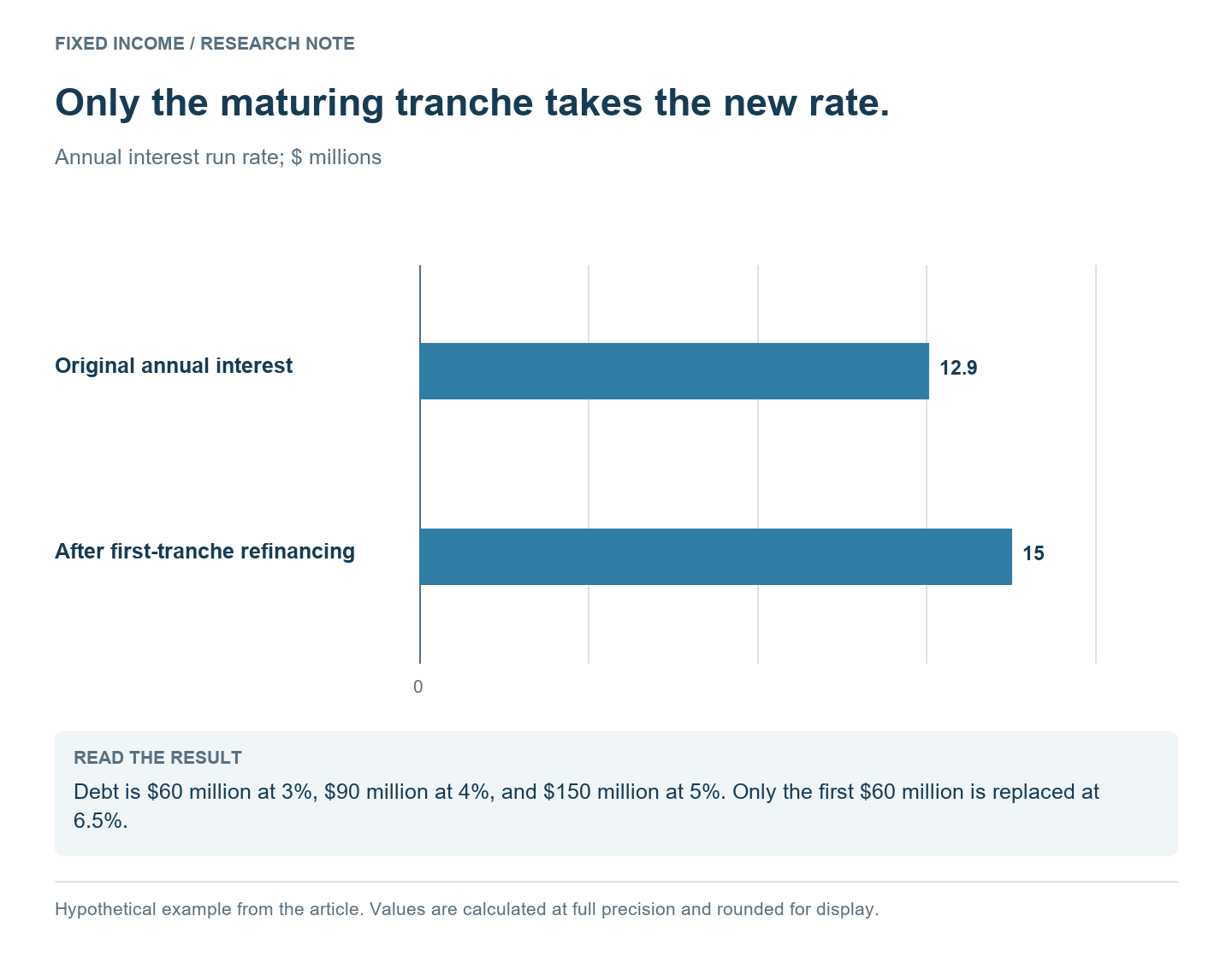
The phrase annual run rate matters. If the refinancing closes partway through a fiscal year, that year's reported cash interest will contain some months at the old rate and some at the new rate. Reporting a full year's incremental cost in the first partial year would misstate timing. The case compares steady annual costs after replacement so the rate effect is clear.
A wider scenario range helps reveal the exposure. Refinancing the $60 million at 5.5% would produce $3.3 million of annual interest on that tranche and $14.4 million overall. At 7.5%, the tranche would cost $4.5 million and total annual interest would be $15.6 million. Those outcomes are conditional calculations, not forecasts of the available financing rate.
Separate the benchmark from the credit margin
For a quote, assume a maturity-matched benchmark of 4% and a credit margin of 2.5 percentage points, producing a 6.5% borrowing yield. If the benchmark remains 4% but the required margin widens to 3.5 percentage points, the new yield becomes 7.5%. An unchanged benchmark does not prevent financing from becoming more expensive.
Alternatively, the benchmark could rise to 4.5% while the margin narrows to two percentage points, leaving the combined yield at 6.5%. The same total rate can conceal different changes in the interest-rate environment and the issuer's relative credit pricing.
In an actual bond issue, coupon, issue price, yield, and fees need to be distinguished. A coupon is not automatically the all-in cost if debt is sold at a discount or carries substantial issuance expenses. Our example assumes par issuance to avoid confusing those effects with the benchmark-and-margin example.
The benchmark also must match the proposed borrowing's characteristics. A current overnight policy range is not a substitute for the market curve relevant to a multi-year corporate issue. Currency, maturity, fixed versus floating terms, and option features can all change the appropriate comparison.
Gross proceeds do not equal cash available for redemption
Assume the new $60 million borrowing carries issuance costs equal to 1% of its face amount. The fee is $600,000. If deducted from proceeds, the company receives only $59.4 million while the old principal repayment remains $60 million.
The company can cover the $600,000 difference with available cash, but it must identify that cash in the plan. Describing the refinancing as a one-for-one replacement without mentioning the fee leaves a funding gap. Other costs, accrued interest, or redemption terms could create additional uses of cash in a real transaction.
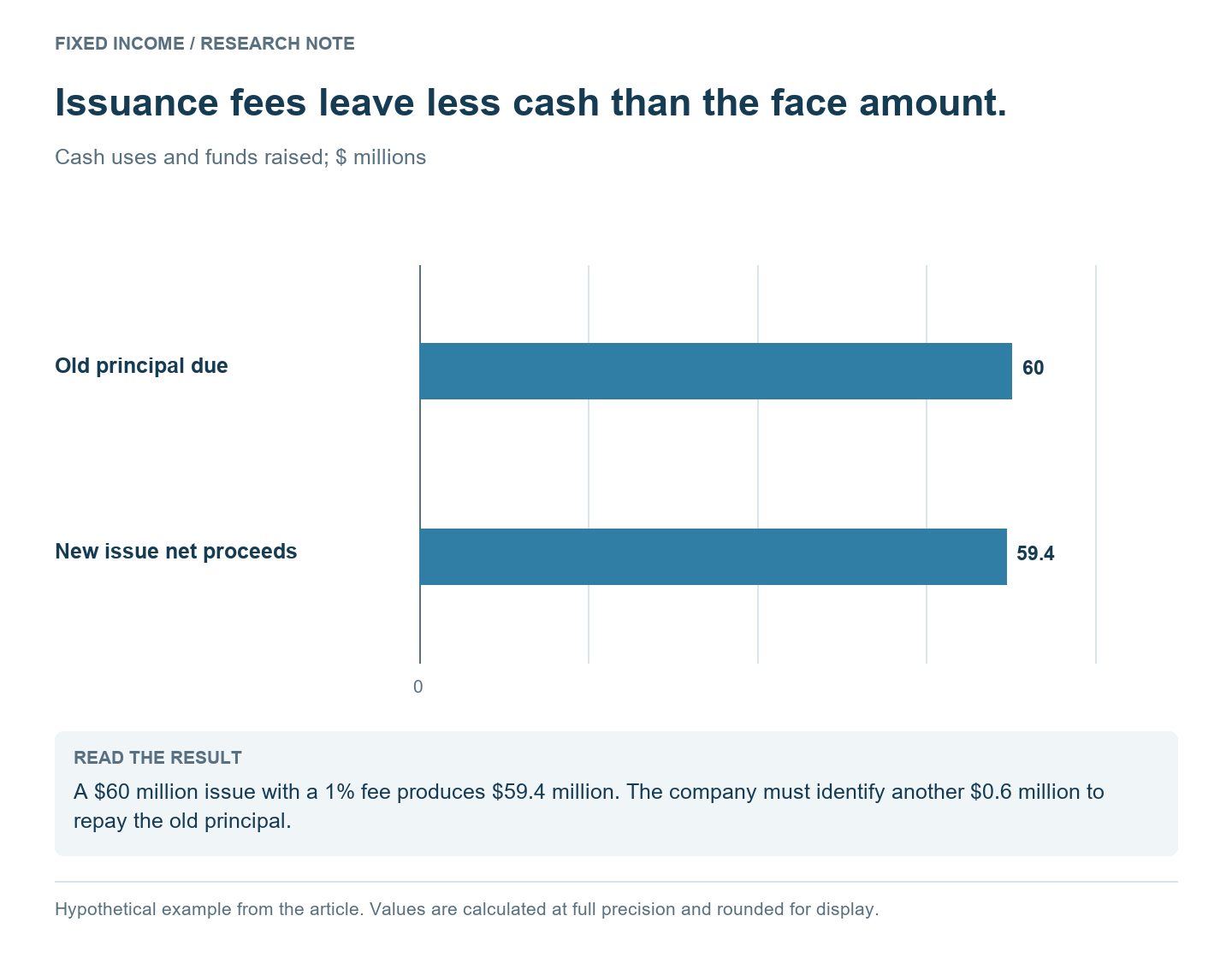
If the company instead wanted exactly $60 million of net proceeds after a 1% fee and had no other deductions, the required gross issuance would be approximately $60.6061 million. Divide the net requirement by 0.99. Adding exactly 1% to $60 million is not quite sufficient because the fee also applies to the additional borrowing.
That larger gross issue would itself carry interest. The main $15 million annual interest example assumes $60 million gross borrowing and payment of the fee from separate cash. Keeping the funding alternatives separate prevents a fee-adjusted principal amount from silently entering a coupon calculation based on the smaller original amount.
Available cash requires a timing and access test
Suppose the company reports $35 million of cash. Of that amount, $5 million is restricted and unavailable for this redemption, while $15 million is needed as a minimum operating balance. Under those assumptions, only $15 million is initially available for discretionary debt repayment or financing costs.
Now suppose the business is expected to generate another $4 million of free cash before the June maturity, after the existing interest, taxes, necessary investment, and operating requirements included in the forecast. Total funds available for the transaction become $19 million. Cash expected after the maturity cannot be counted as though it were already available before it.
The projection needs to respect seasonality. A company that earns most of its annual cash late in the year can face a spring financing gap despite reporting a positive annual total. Inventory purchases, tax installments, maintenance shutdowns, and supplier payments can make the path within the year more important than the year-end figure.
The $4 million forecast is also an assumption, not a committed financing source. It should be stressed for weaker collections or higher working-capital needs. A maturity plan that depends on every forecast dollar arriving exactly on time has less flexibility than one with usable buffers or confirmed alternative funding.
Using cash reduces borrowing but consumes flexibility
Consider an alternative to refinancing the full $60 million. Suppose the company uses all $19 million of the identified available cash and borrows only the remainder, while still paying a fee equal to 1% of the new gross borrowing. The net borrowing need is $41 million, so the gross issue must be approximately $41.4141 million.
The fee is approximately $414,141, leaving $41 million of net proceeds. Combined with $19 million of cash, those proceeds repay the $60 million maturity. At a 6.5% coupon, annual interest on the new borrowing is approximately $2.6919 million. Adding the unchanged $11.1 million from the other tranches produces an annual interest run rate of approximately $13.7919 million.
This is lower than the $15 million run rate under full replacement, but the company has used its discretionary cash buffer. Under the assumptions, the remaining cash consists of the $5 million restricted amount and the $15 million operating minimum. The lower borrowing cost comes with less immediately available flexibility for an unexpected outflow.
Neither branch is automatically superior. The comparison depends on operating volatility, alternative liquidity, investment needs, and financing conditions. The analysis should show both the reduction in debt and the reduction in usable cash rather than celebrating one side of the transaction in isolation.
Prefunding exchanges some market risk for carrying cost
The company might issue the full replacement debt before the old debt matures and retain the proceeds until repayment. That can reduce uncertainty about future market access, provided the financing closes and the proceeds remain available. It can also create a period in which both old and new debt are outstanding.
For a separate simplified timing exercise, assume exactly eight months of overlap. The new $60 million debt costs 6.5% annually, producing $2.6 million of interest over eight months using simple proportional accrual. If the proceeds earn 3.75% annually during the same period, they generate $1.5 million. The incremental net carrying cost is $1.1 million before fees and taxes.
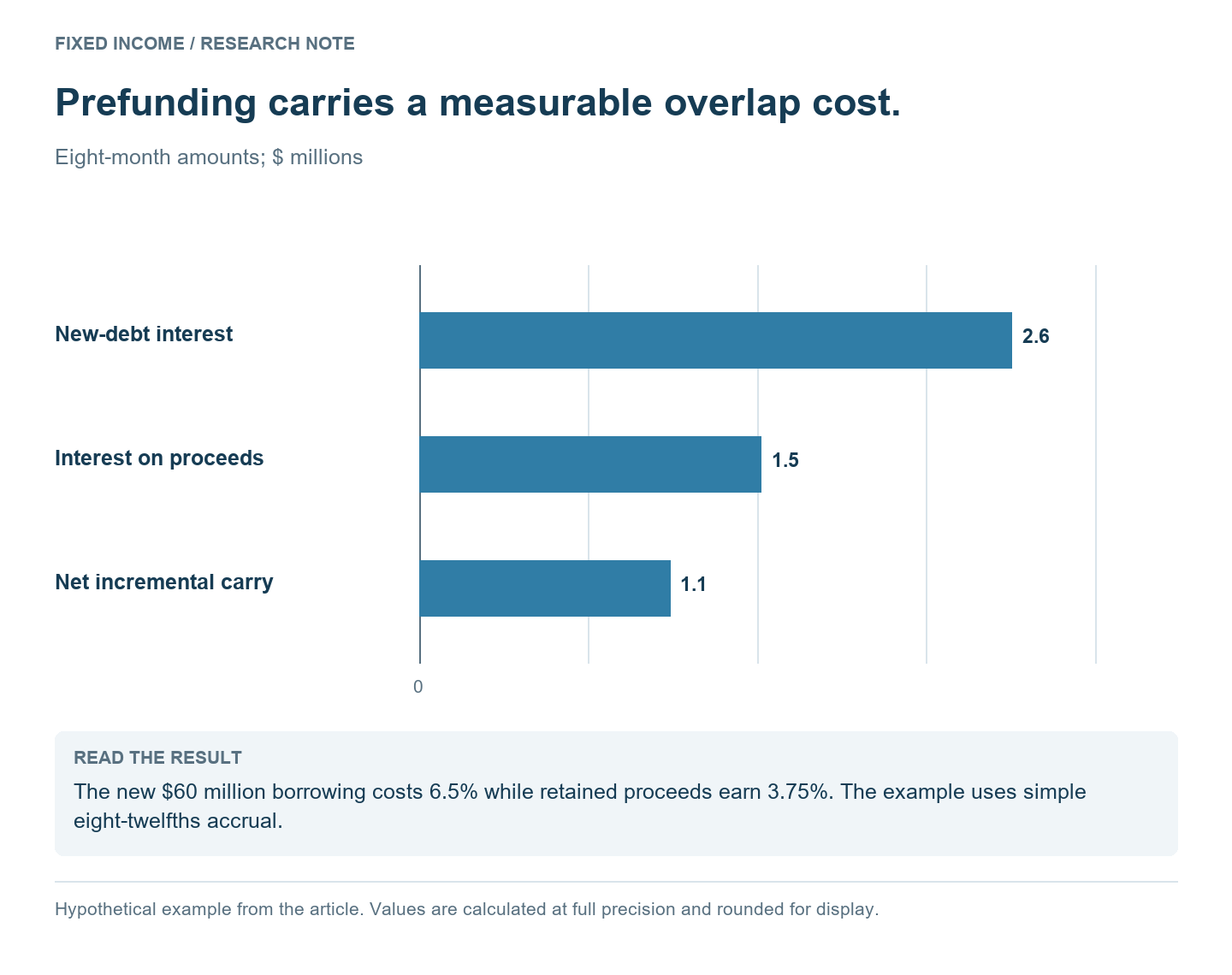
The old tranche's interest during those months is not an additional cost created by prefunding; it would be owed while the old debt remained outstanding anyway. The incremental comparison isolates the new debt's interest less the return on its retained proceeds. A full cash forecast includes all payments, but a decision comparison should not count the existing obligation twice.
The eight-month interval determines how long the proceeds can earn interest. Match the liquidity, credit exposure, and maturity of the reinvestment to the redemption date. Taking extra risk with funds reserved for repayment can defeat the purpose of prefunding.
The overlap can affect contractual limits
Prefunding also changes the gross balance sheet before the old principal is retired. In the full-replacement example, gross debt temporarily rises from $300 million to $360 million. Cash rises by the new proceeds, less fees, but a covenant may not give unlimited credit for that cash.
Assume a separate covenant measures gross debt divided by $75 million of EBITDA and permits no more than 4.5 times. Initial gross leverage is 4.0 times. During the overlap, it becomes 4.8 times, exceeding that limit. A substantial cash balance does not fix a ratio explicitly defined using gross debt.
A real agreement might use net debt, allow designated refinancing debt, restrict which cash can be deducted, or contain another definition entirely. The example is not a legal interpretation of an actual covenant. It shows why financing availability and contractual permission must be checked together before assuming early issuance is possible.
Other restrictions may concern collateral, guarantees, restricted subsidiaries, or the use of proceeds. A transaction can improve the maturity profile while changing protections available to existing creditors. The calendar analysis should therefore track the new obligation's terms, not merely replace one maturity date with a later date.
Market access is not the same as a displayed yield
A quoted yield on an outstanding bond can inform a financing estimate, but it is not a binding offer to underwrite a new issue of any size. New investors may require a concession, different covenants, collateral, or a shorter maturity. The amount the company wants to borrow may exceed the demand available on the assumed terms.
Bank financing presents its own conditions. A facility can be committed yet subject to representations, covenants, collateral tests, or limits on permitted use. Undrawn capacity should be counted only to the extent it is available for the relevant purpose under the scenario being examined.
Distinguish the stages of a financing plan. Management's intention to refinance is not an executed commitment. An announced transaction is not necessarily closed funding. Cash received and available for redemption is a stronger resource than an expectation that markets will remain receptive. A research record should identify the stage rather than use the word refinanced for every part of the process.
Contingencies matter when the main plan is delayed. An asset sale, retained earnings, an equity contribution, or a bridge facility can provide alternatives, but each has timing, cost, and execution assumptions. A list of possible options is not equivalent to having each option secured and available simultaneously.
The maturity ladder explains gradual pressure
Return to the full-replacement branch, with no principal reduction. After the first refinancing, annual interest is $15 million. If the $90 million tranche later refinances at the same 6.5% rate, its annual cost rises from $3.6 million to $5.85 million. Total annual interest would then become $17.25 million while the final $150 million tranche still pays 5%.
If all $300 million were eventually financed at 6.5%, annual interest would be $19.5 million. That is $6.6 million above the initial $12.9 million. This constant-rate scenario isolates transmission through the calendar. It does not establish that 6.5% borrowing will be available in 2029 or 2032.
The company therefore can experience rising interest expense over several years even if market borrowing rates remain unchanged throughout that scenario. Old low-coupon debt is gradually replaced by debt priced at the newer rate. The policy setting can be stable while the weighted cost of the existing debt stock continues moving.
The converse can occur after rates fall. A company with long fixed-rate debt may not immediately benefit from lower market rates, particularly if repayment is restricted or costly. The maturity and option structure determines how quickly the new environment reaches cash expenses. Aggregate statements about rate sensitivity need that calendar underneath them.
Test the business alongside the financing plan
A collection delay shows how an operating assumption can alter the funding requirement without any change in policy. In the partial-repayment branch, the company expected $4 million of free cash before maturity, giving it $19 million available in total. Suppose a working-capital disruption instead produces a $2 million cash outflow over that interval.
Available cash becomes $13 million: the original $15 million discretionary balance less the $2 million outflow. The net financing requirement rises from $41 million to $47 million. With the same 1% fee on gross issuance, the company must borrow approximately $47.4747 million to obtain $47 million net.
At the unchanged 6.5% coupon assumption, annual interest on that new issue is approximately $3.0859 million. Including the unchanged tranches gives an annual run rate of approximately $14.1859 million. The borrowing rate did not rise, but the interest burden increased because less internal cash was available to repay principal.
The disruption need not represent a permanent loss of revenue. Cash might arrive after the maturity date. Even so, it cannot fund a payment due before its arrival without another financing arrangement. A later receipt may help repay borrowing, but early repayment rights and costs determine whether the company can immediately reverse the transaction.
If the same disruption also weakens lender confidence, the financing rate or permitted borrowing amount could change as well. That would be a separate, combined stress. Keeping the first calculation's rate fixed isolates the amount effect and makes the more complex scenario easier to interpret afterward.
The working record should therefore track forecast revisions in both dimensions: how much financing is needed and what it costs. A rate-only sensitivity table can miss a funding gap created by collections, inventory, or a delayed disposal. An amount-only forecast can miss the cash burden imposed by more expensive replacement debt.
Updating the calendar regularly turns those changes into visible decisions while alternatives still exist. Waiting until the old bond is nearly due can compress the available choices, even when the company remains economically viable over a longer horizon.
A sustainable refinancing requires more than replacing principal once. The company must support the new interest burden while maintaining the operations that generate repayment cash. Maintenance spending, working capital, taxes, and other commitments cannot be ignored simply because an earnings measure appears strong.
Stress operating performance and financing terms together. Weaker cash generation can reduce the amount available for repayment, while a wider credit margin raises the cost of the additional borrowing required. A delayed asset sale can move both the amount and timing of the funding need. These interactions are more informative than changing a coupon assumption in isolation.
Keep the alternatives internally consistent. If one scenario uses cash to reduce principal, lower the debt balance and the cash buffer in that same scenario. If another prefunds, include the overlap and carrying cost. If a scenario assumes a covenant limits new borrowing, do not also count unlimited borrowing as its fallback.
The October policy hold is one entry in this analysis, not its conclusion. The most useful credit questions remain dated and specific: what comes due, what resources can reach it on time, what terms replace it, and what capacity remains afterward? A refinancing calendar connects those questions to the actual obligations a bondholder depends on.
Related research

ResearchFixed Income
Matching Bond Cash Flows to a Spending Need
The right bond horizon depends on the payment the money must support. Three cases distinguish a fixed invoice, an inflation-sensitive purchase, and an uncertain payment date, showing why maturity, duration, and available cash solve different problems.

ResearchFixed Income
Income, Price Changes, and Reinvestment Make Up Total Return
Coupon income is only one part of a bond investment's result. A complete cash-flow reconciliation distinguishes price changes, reinvestment earnings, costs, and outside contributions—and explains why an initial yield and a realized compound return can differ.

ResearchFixed Income
Liquidity Can Disappear Before a Bond Defaults
A bond can keep paying while becoming difficult to sell at its displayed value. An original execution example separates the quoted spread, available transaction size, price impact, and settlement timing that determine how much cash a holder can actually raise.