
ResearchGlobal Macro
Why Global Forecasts Change Without the World Changing Overnight
- Report or archive date
- Archive placement October 15, 2026
- Reading time
- 2 min read

Summary
Reading forecast revisions as conditional updates rather than scores of certainty.
A forecast is a structured statement about an uncertain future. Its value lies in the assumptions, mechanisms, and risks it makes explicit. A small revision can reflect new data, different policy assumptions, or a change in the composition of growth. It need not signal that the economy suddenly crossed into a new regime.
Compare like with like
The IMF projected 2026 global growth at 3.3% in January and 3.1% in October. These figures are forecast vintages, not two measurements of final realized growth. They should not be presented as though the full year’s outcome had already been observed.
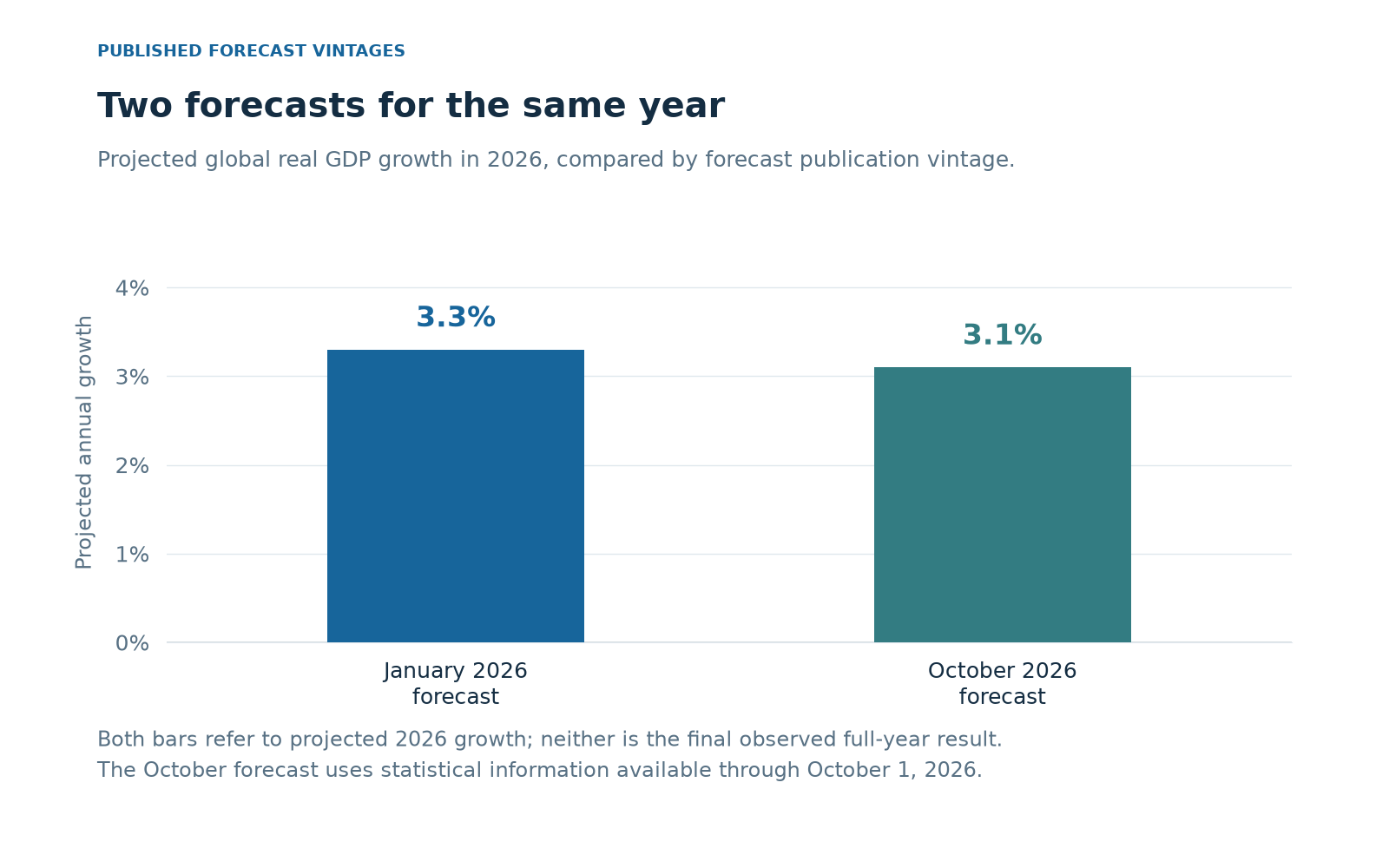
The comparison becomes more informative when the analyst asks what changed inside the aggregate. An improvement in a large economy can offset deterioration elsewhere. Technology investment can support one group of countries while higher import costs pressure another. An unchanged world total can conceal a substantial redistribution of economic stress.
How Different Assumptions Change the Growth Outlook
A useful forecast discussion separates a baseline from alternatives. For example, a scenario with easing energy disruption might support real incomes and reduce price pressure. A scenario with more persistent disruption could weaken demand while keeping inflation uncomfortable. Neither is a prediction merely because it is plausible.

The October outlook used a statistical cutoff of October 1. Events after that date may matter for a reader’s assessment, but they should not be attributed to the forecast itself. The same discipline applies when comparing national data released on different schedules.

Use forecasts as inputs
Portfolio construction requires more than choosing the institution with the most attractive growth number. The relevant question is how an asset’s cash flows and valuation behave across a range of outcomes. An economy can outperform a forecast while its stock market disappoints if prices already anticipated an even better result.
The most productive use of a forecast is to make a research process testable. Record the assumptions, identify the releases that could challenge them, and revise the interpretation when evidence changes. Confidence should come from a transparent process, not from presenting a single decimal place as certainty.
Related research

ResearchGlobal Macro
Productivity Gains Need a Route Into Earnings
Why an attractive technology narrative still requires evidence about costs, adoption, and demand.

ResearchGlobal Macro
A Stronger Currency Creates Winners and Losers
The same exchange-rate move can help a consumer, hurt an exporter, and change a portfolio return.
ResearchGlobal Macro
Fiscal Support Today, Financing Questions Tomorrow
A framework for evaluating public spending without reducing the debate to one debt ratio.