
ResearchFixed Income
A Credit Spread Is Compensation, Not a Cushion You Can Spend Twice
- Report or archive date
- Archive placement May 14, 2026
- Reading time
- 1 min read

Summary
Assessing the extra yield on corporate debt requires separating credit and interest-rate risks.
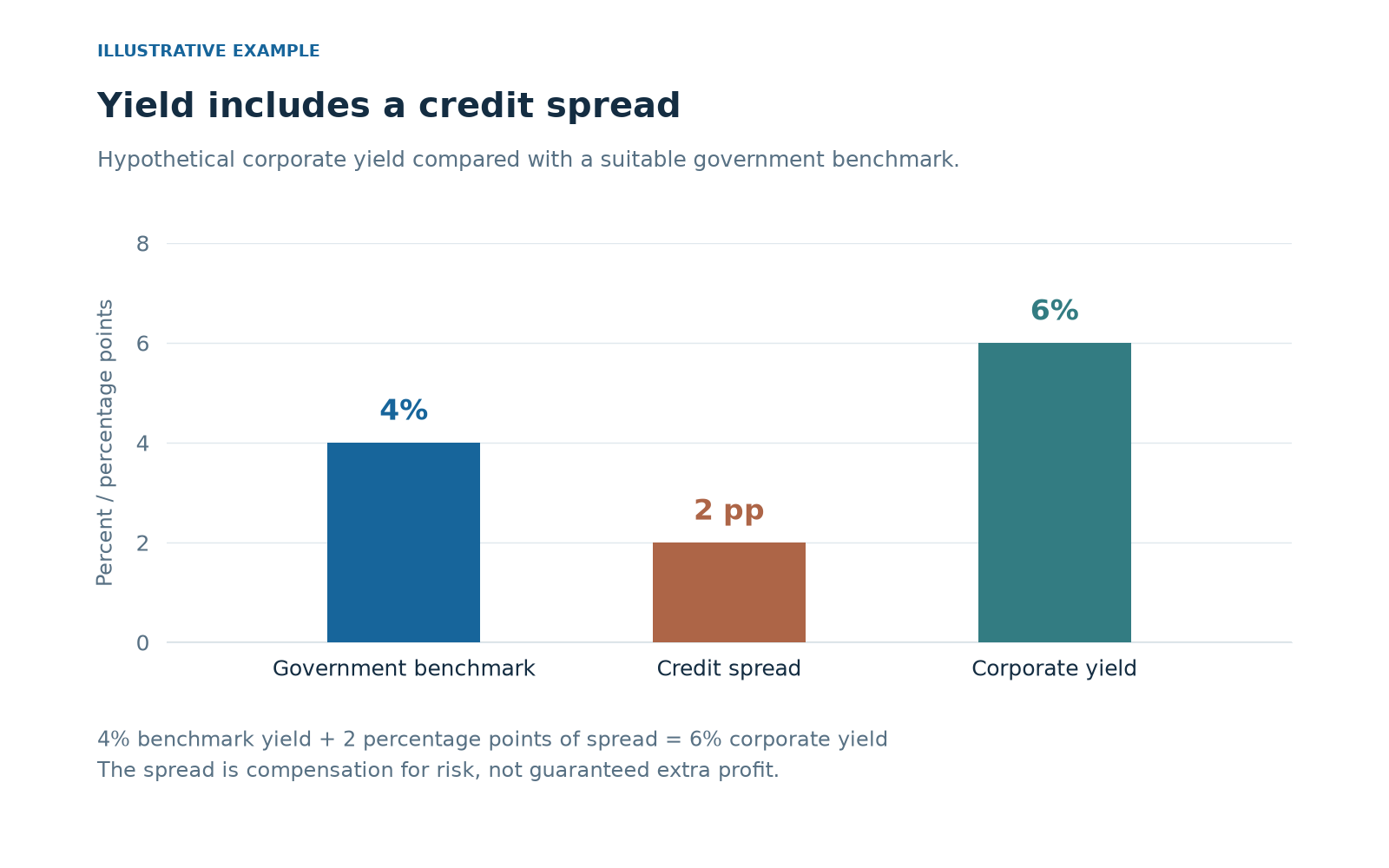
Corporate bonds usually offer additional yield relative to a suitable government benchmark. That spread compensates investors for a combination of default risk, uncertainty, liquidity, and other pricing factors. It is not a guarantee that the investor will earn the quoted difference.
Separate the sources of return
Bondholders face the possibility that an issuer fails to make promised payments, along with interest-rate and liquidity risks. A corporate bond’s price can therefore change even if the government yield used as its benchmark is unchanged.

Consider a corporate bond yielding 6% when a comparable government bond yields 4%. The two-percentage-point spread is not pure expected profit. Defaults and recoveries can reduce realized returns, while widening spreads can cause price losses before any default occurs.
If government yields fall but the credit spread widens by more, the corporate bond’s total yield can rise and its price can decline. Describing that bond simply as protection against falling interest rates would miss the credit exposure.
Examine the refinancing path
The key business questions include recurring cash generation, debt maturities, interest coverage, collateral, and access to funding. A company with manageable current interest expense may still face difficulty when inexpensive debt matures and must be refinanced at a higher rate.
Sector conditions also matter. A business can appear healthy during a commodity upswing or a period of unusually strong pricing. Stressing earnings and funding costs together provides a more demanding test than changing one assumption at a time.

Define adequate compensation
There is no universal spread that makes a bond attractive. The answer depends on the issuer, the bond’s contractual protections, the expected recovery in distress, and the investor’s time horizon. Ratings can organize the analysis but cannot replace it.
A useful credit conclusion explains the conditions under which the promised cash flows remain plausible and the losses that could occur if those conditions fail. Extra yield is payment for accepting uncertainty. It should be evaluated against that uncertainty rather than treated as income available without a corresponding risk.
Related research

ResearchFixed Income
The Yield Curve Has More Than One Story to Tell
Changes in curve shape can reflect policy expectations, inflation risk, and term compensation.

ResearchFixed Income
What TIPS Protect—and What They Leave Exposed
Inflation adjustment is a contractual feature, not a guarantee of a stable market value.

ResearchFixed Income
Duration Turns a Rate View Into a Risk Estimate
A bond’s yield tells only part of the story; price sensitivity determines the near-term exposure.