
ResearchFixed Income
Duration Turns a Rate View Into a Risk Estimate
- Report or archive date
- Archive placement January 29, 2026
- Reading time
- 2 min read

Summary
A bond’s yield tells only part of the story; price sensitivity determines the near-term exposure.
A bond can offer an attractive yield and still experience a substantial price decline. The missing link is duration: a measure used to approximate how sensitive its price is to changes in yield. Understanding that sensitivity helps distinguish income expectations from the risk of selling before maturity.
Using Modified Duration to Estimate Bond-Price Changes
Fixed-rate bond prices generally move inversely to market yields. Modified duration provides a first-order approximation of the percentage price change for a small change in yield, holding other relevant factors constant.
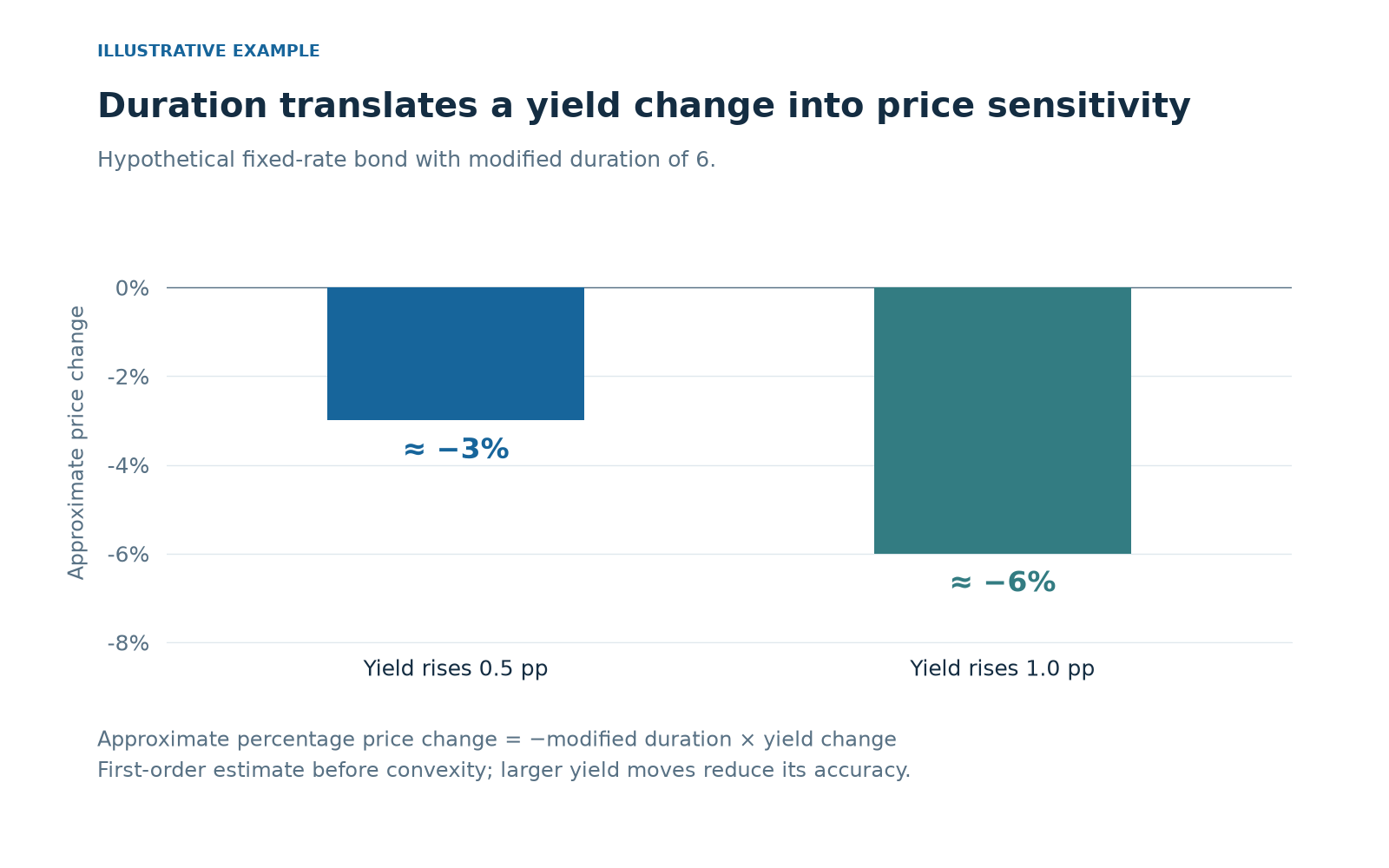
For a bond with modified duration of six, a one-percentage-point rise in yield implies an approximate 6% price decline before convexity and other effects. A half-point increase implies roughly 3%. These are illustrations, not forecasts or exact price calculations. Larger yield changes make the linear approximation less reliable.
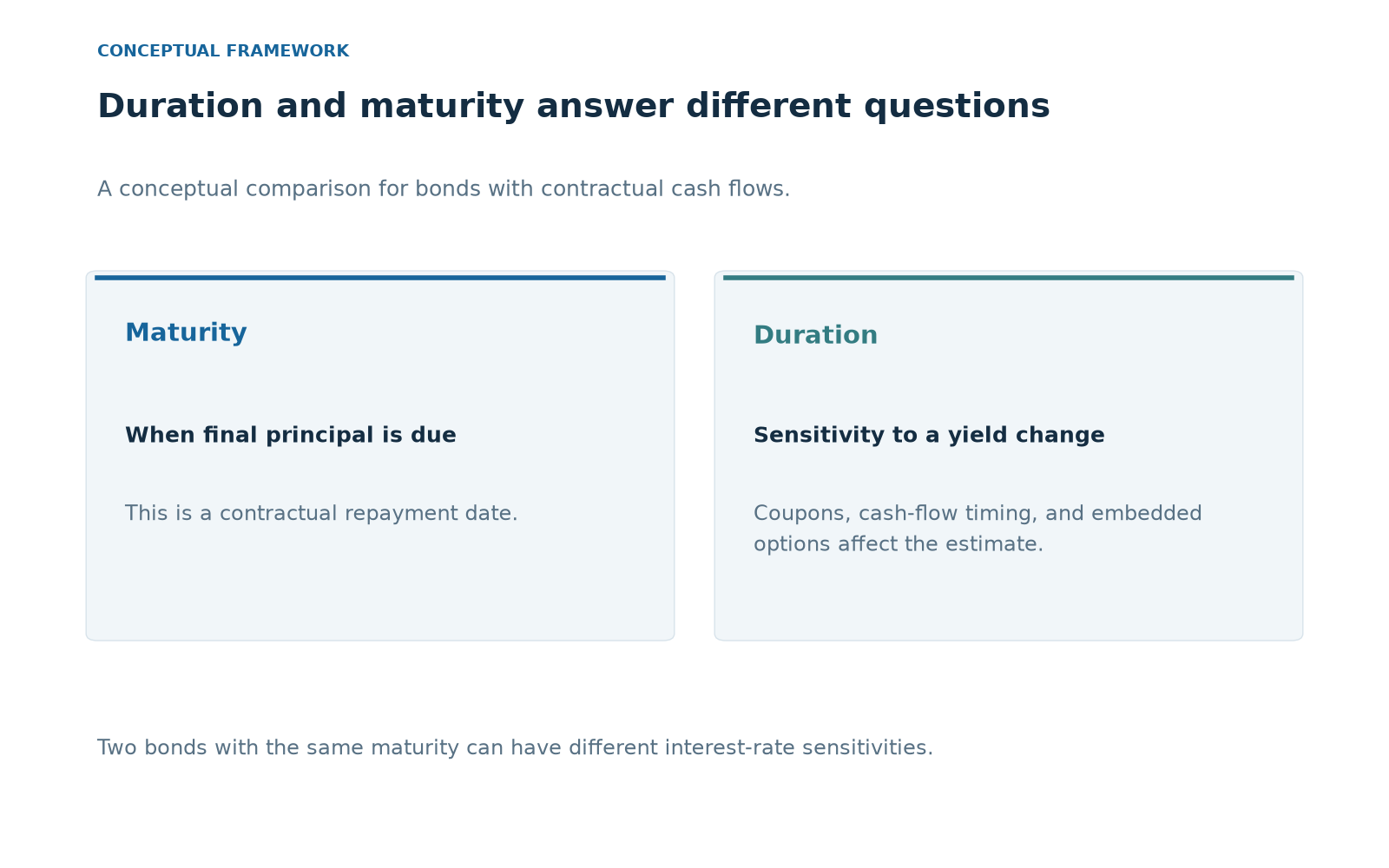
Duration is not the same as maturity. Coupon payments return part of the investment before final repayment, and embedded options can alter cash-flow timing. Two bonds with the same maturity may therefore have different sensitivities.

Match the measure to the question
An investor planning to meet a known liability in several years faces a different problem from one who may need to sell next month. The first may care about matching cash flows and the issuer’s ability to pay. The second is more exposed to interim price changes and market liquidity.

Holding to maturity does not remove every risk. Credit losses, inflation, reinvestment of coupons, and the opportunity cost of a fixed rate remain relevant. A bond fund also does not generally promise to return a particular principal amount on an individual investor’s chosen date.
Build a complete assessment
Duration should be read alongside credit quality, spread sensitivity, currency exposure, and liquidity. A portfolio can have modest interest-rate duration but meaningful credit risk. Conversely, a high-quality long-term government bond can carry considerable price sensitivity. The useful conclusion states what kind of risk is being taken and over what horizon, rather than describing all fixed income as conservative.
Related research

ResearchFixed Income
The Yield Curve Has More Than One Story to Tell
Changes in curve shape can reflect policy expectations, inflation risk, and term compensation.

ResearchFixed Income
A Credit Spread Is Compensation, Not a Cushion You Can Spend Twice
Assessing the extra yield on corporate debt requires separating credit and interest-rate risks.

ResearchFixed Income
What TIPS Protect—and What They Leave Exposed
Inflation adjustment is a contractual feature, not a guarantee of a stable market value.