
ResearchFixed Income
What TIPS Protect—and What They Leave Exposed
- Report or archive date
- Archive placement June 18, 2026
- Reading time
- 1 min read

Summary
Inflation adjustment is a contractual feature, not a guarantee of a stable market value.
Treasury Inflation-Protected Securities link principal to a consumer-price index. That makes them different from conventional nominal bonds, but it does not make them immune to losses over every holding period. The distinction between contractual payments and the market price is essential.
Understand the contract
TreasuryDirect explains that TIPS principal adjusts with inflation or deflation, and that the maturity payment is the greater of adjusted principal or original principal. That floor applies to original principal at maturity. It does not guarantee recovery of a higher price paid in the secondary market.
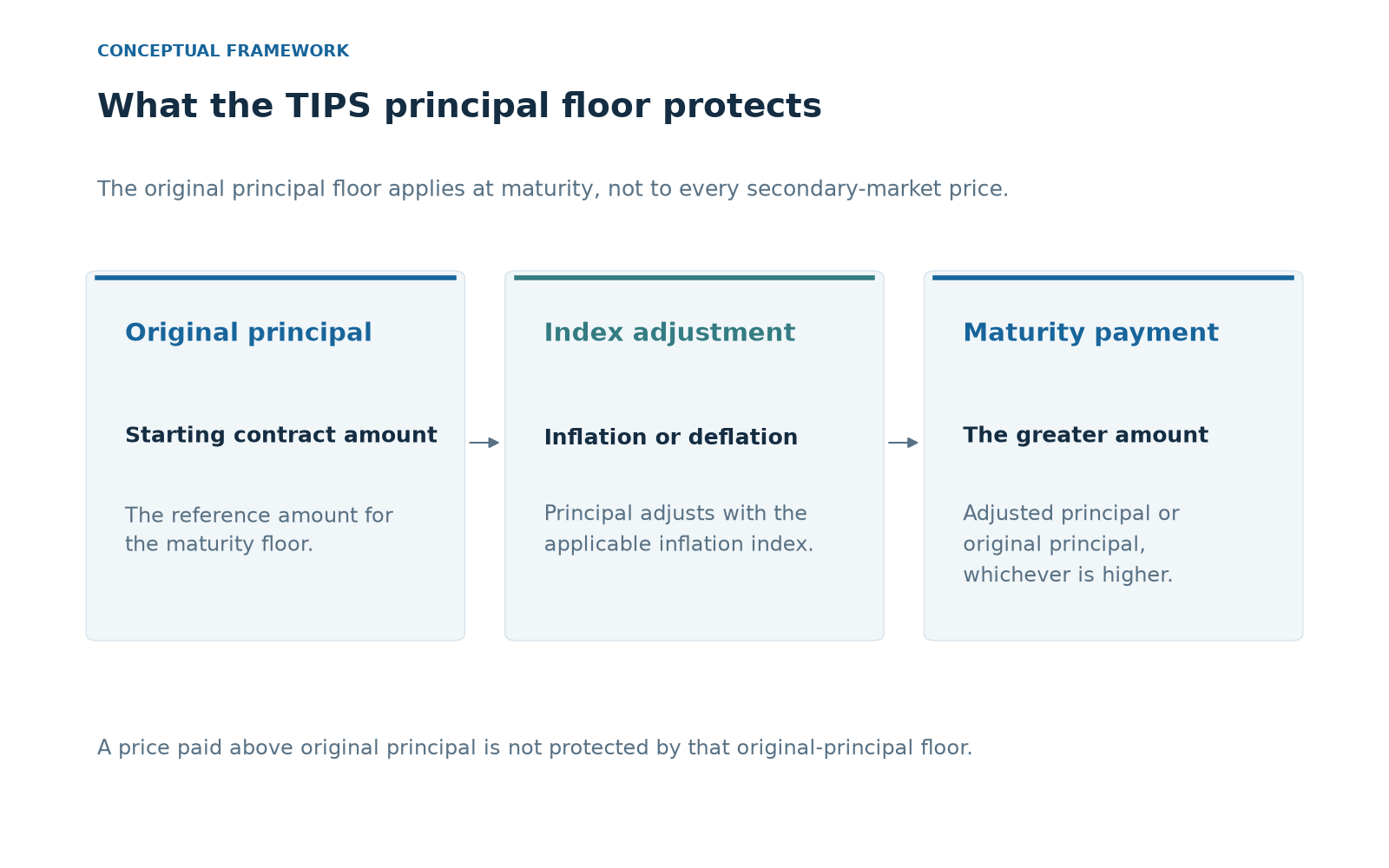
The coupon rate is applied to adjusted principal, so the dollar interest payment can change. The inflation index also represents a broad consumption basket rather than any particular household’s spending. Someone whose expenses are concentrated in housing, health care, or education can experience inflation differently.
Separate inflation from real yields
A TIPS market price is sensitive to changes in real yields. If investors require a higher real return, the price can decline even while principal is receiving an inflation adjustment. A holder who sells before maturity therefore faces market risk.
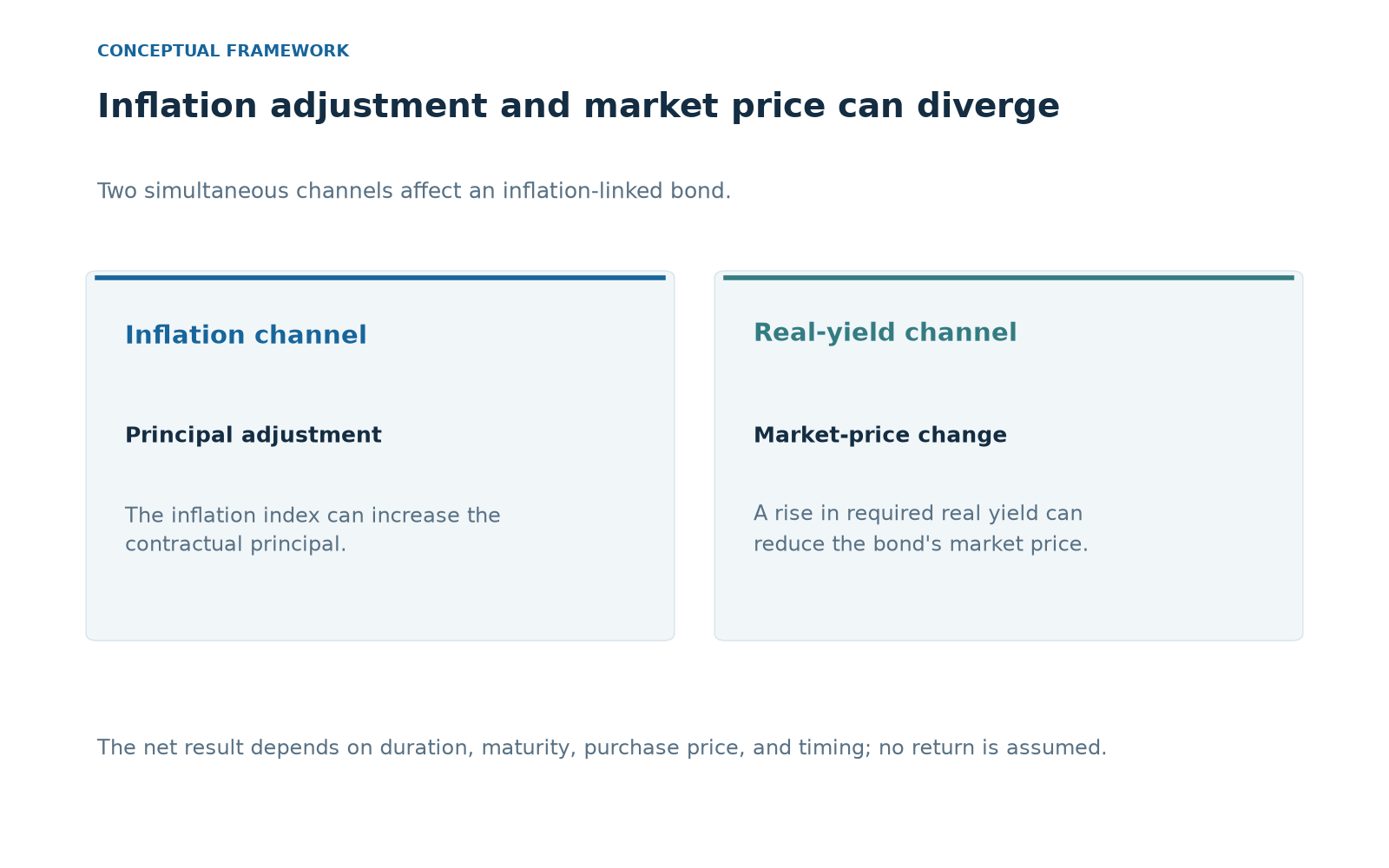
In this example, an inflation adjustment adding value to principal can be more than offset by a price decline caused by rising real yields. The precise result depends on maturity, duration, purchase price, and the timing of inflation adjustments. No single inflation number determines the total return.

What Breakeven Inflation Rates Measure
The difference between comparable nominal and inflation-linked yields is often called breakeven inflation. It reflects more than a pure forecast: inflation risk compensation, liquidity differences, and technical factors can contribute. It should not be quoted as the market’s certain prediction of future consumer prices.
TIPS can help address some inflation exposure when matched to an appropriate horizon. They still require attention to purchase price, maturity, taxes, and personal liabilities. The strongest analysis states which purchasing-power risk is being addressed and which risks remain. A useful protection mechanism is more credible when its limits are explicit.
Related research

ResearchFixed Income
A Credit Spread Is Compensation, Not a Cushion You Can Spend Twice
Assessing the extra yield on corporate debt requires separating credit and interest-rate risks.

ResearchFixed Income
Cash Has Reinvestment Risk Too
A stable balance today does not lock in tomorrow’s income.

ResearchFixed Income
The Yield Curve Has More Than One Story to Tell
Changes in curve shape can reflect policy expectations, inflation risk, and term compensation.