
ResearchFixed Income
The Yield Curve Has More Than One Story to Tell
- Report or archive date
- Archive placement March 26, 2026
- Reading time
- 1 min read

Summary
Changes in curve shape can reflect policy expectations, inflation risk, and term compensation.
The yield curve compares interest rates across maturities. Its shape summarizes market pricing, but the same change in shape can arise from different causes. A steeper curve can accompany improving growth, rising inflation concern, or falling short-term rates. Those possibilities imply different outcomes for investors.
Describe the move precisely
In this example, a two-year yield falls from 4% to 3.5% while a ten-year yield stays at 4.2%. The curve steepens because the short end declines. In a second example, the two-year stays at 4% and the ten-year rises from 4.2% to 4.7%. The curve also steepens, but long-term bond prices face a different result.
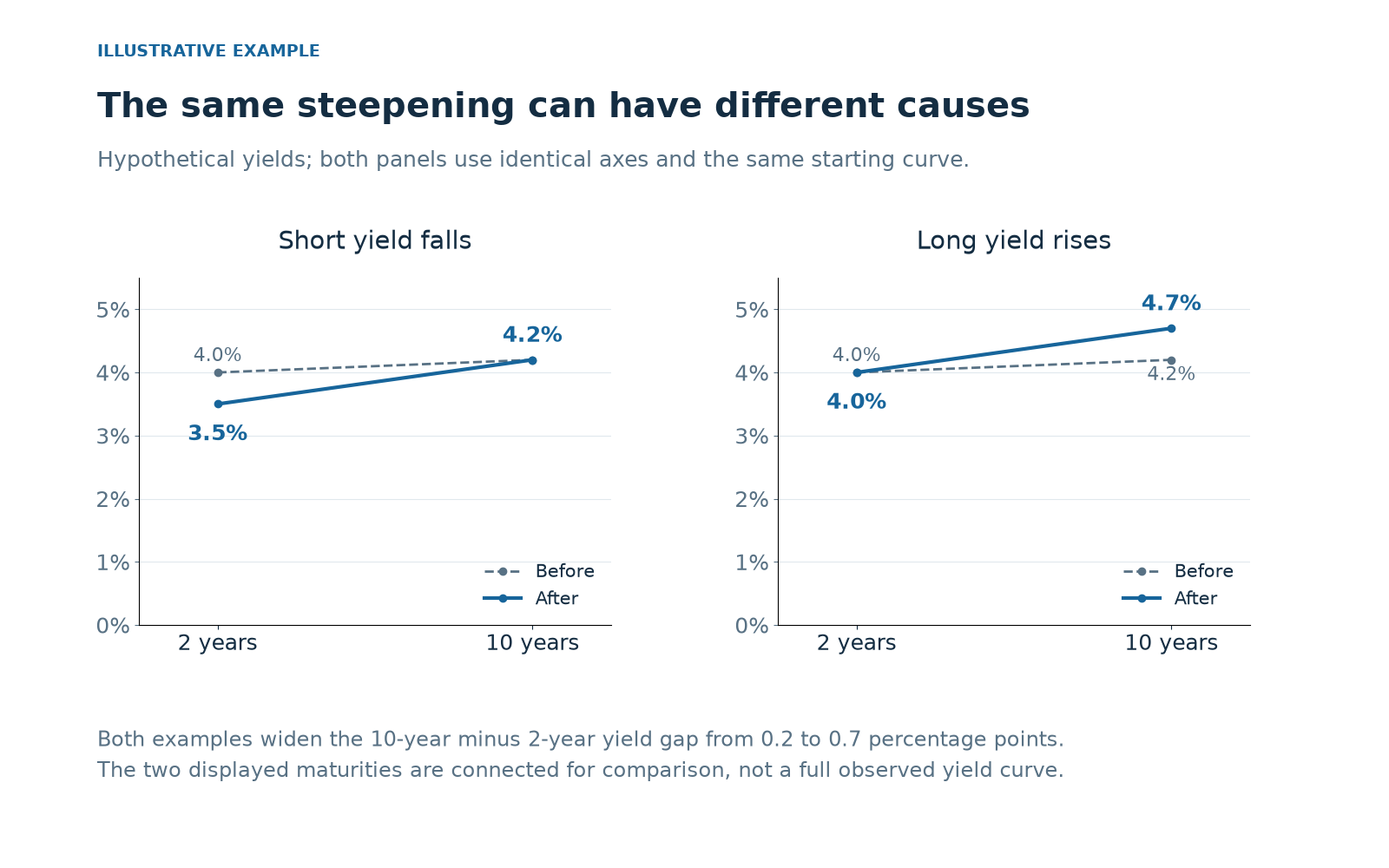
Bond prices and yields move inversely for fixed contractual cash flows. That relationship explains why a statement about curve shape is insufficient to describe portfolio performance. The maturity exposure and the actual yield changes matter.
Separate the possible drivers
Longer-term yields reflect expected future short rates as well as compensation for holding interest-rate and inflation risk over time. Supply, liquidity, and investor demand can also affect pricing. No single curve observation reveals the precise contribution of each force.

An inversion can indicate expectations of lower future policy rates, but it does not provide a complete timetable for an economic downturn. The reason rates are expected to fall matters: easing inflation, weaker demand, or a financial disruption can produce different earnings and credit consequences.

Translate the curve into a research question
For a borrower, the curve affects the cost of locking in financing. For a saver, it affects the trade-off between current income and the uncertainty of reinvesting later. For a portfolio, it helps identify which maturities would be most exposed to a change in the outlook.
A disciplined note names the maturities, describes the direction of the move, and offers competing explanations. It then identifies the evidence that would distinguish them. The curve is valuable because it compresses information; analysis is necessary because it does not explain that information on its own.
Related research

ResearchFixed Income
Duration Turns a Rate View Into a Risk Estimate
A bond’s yield tells only part of the story; price sensitivity determines the near-term exposure.

ResearchFixed Income
A Credit Spread Is Compensation, Not a Cushion You Can Spend Twice
Assessing the extra yield on corporate debt requires separating credit and interest-rate risks.

ResearchFixed Income
What TIPS Protect—and What They Leave Exposed
Inflation adjustment is a contractual feature, not a guarantee of a stable market value.