
ResearchEquity Strategy
A Low Price-to-Earnings Ratio Can Be Expensive
- Report or archive date
- Archive placement February 25, 2026
- Reading time
- 1 min read

Summary
Valuation requires a view of earnings durability, not just a ranking of multiples.
A stock trading at a low earnings multiple may offer value. It may also sit near the top of an earnings cycle, carry financial risk, or face a business model in decline. The ratio is a starting point for investigation because its denominator can change as quickly as its numerator.
Test the earnings base
Imagine two companies valued at ten times annual earnings. One earns steady cash from recurring services and has little debt. The other earns unusually high profits from a temporary shortage and must refinance substantial borrowing next year. The identical multiple conceals different risks.

Financial statements make it possible to examine the sources of earnings and the obligations that sit ahead of shareholders. The analyst should distinguish recurring operations from disposals, unusual tax effects, and other items that may not repeat. Adjustments require consistency: removing every unfavorable item while retaining favorable surprises produces a misleading comparison.
Connect price to the future
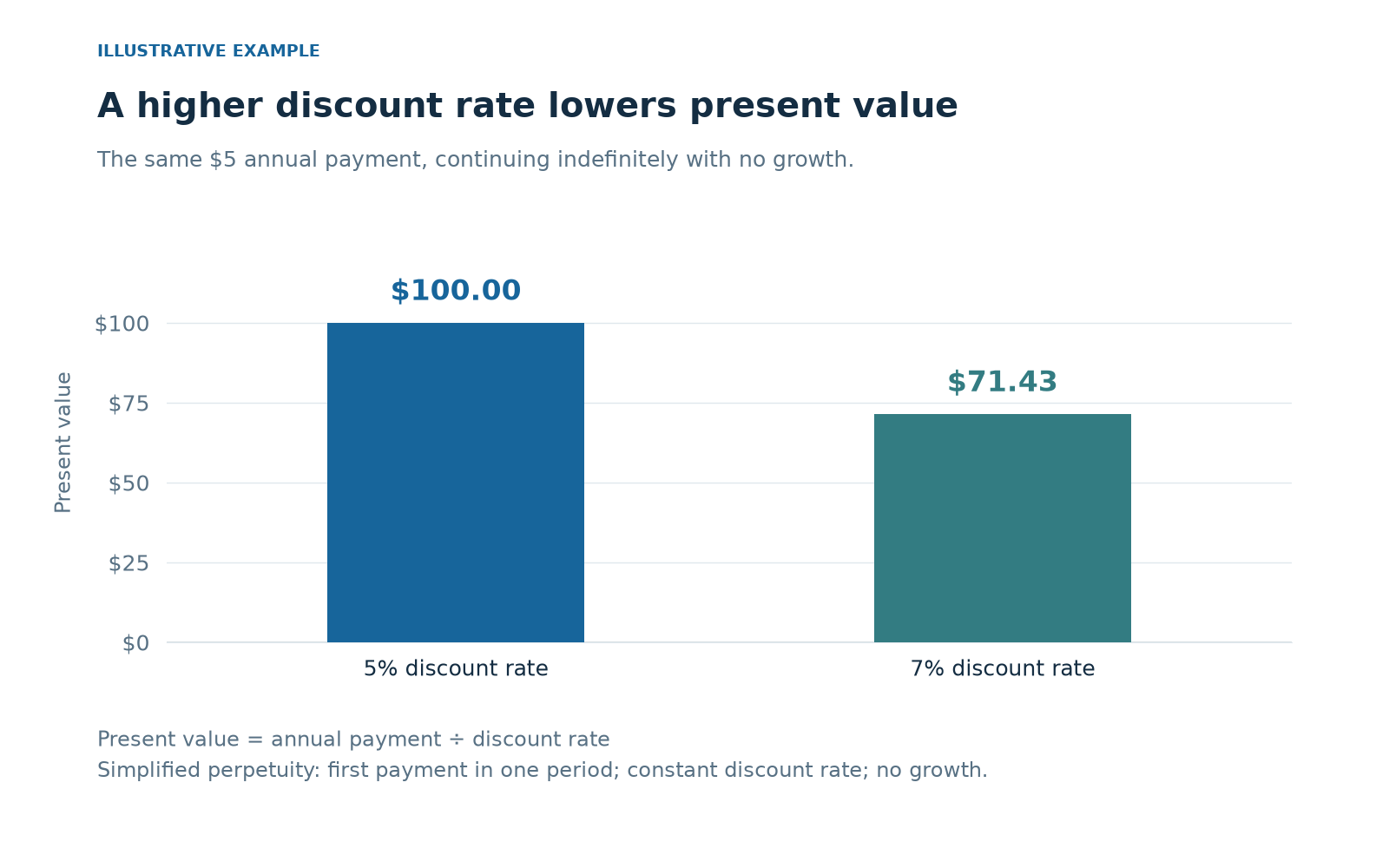
Valuation reflects expectations about future cash, its timing, and the return investors require. In a deliberately simplified example, a perpetual annual cash payment of $5 is worth $100 at a 5% discount rate and about $71 at 7%. This example assumes no growth and a constant discount rate.

The example shows why an unchanged business forecast can support a different price when financing conditions or perceived risk change. It also explains why distant profits can be especially sensitive to the assumptions used to value them.

Compare businesses with care
Sector mix, leverage, accounting policies, reinvestment needs, and the stage of the cycle complicate international or industry comparisons. A broad index may look cheaper because it contains more cyclical or capital-intensive businesses. That is not automatically a mispricing.
A useful conclusion identifies the expectations embedded in the price and asks what must go right for them to be met. The case becomes stronger when it survives conservative assumptions about margins, financing, and growth. A low multiple without that work is an observation, not an investment thesis.
Related research

ResearchEquity Strategy
An Earnings Beat Is Only the Beginning
A practical framework for distinguishing operating progress from accounting and expectation effects.

ResearchEquity Strategy
Pricing Power Must Survive a Customer’s Response
Higher prices improve a business only if volume, retention, and costs cooperate.

ResearchEquity Strategy
Index Concentration Is a Portfolio Exposure, Not a Market Verdict
A rising index can depend on a narrow set of earnings drivers.