
ResearchEquity Strategy
Pricing Power Must Survive a Customer’s Response
- Report or archive date
- Archive placement April 22, 2026
- Reading time
- 2 min read

Summary
Higher prices improve a business only if volume, retention, and costs cooperate.
Pricing power is often invoked when inflation rises. Yet the ability to announce a price increase is different from the ability to retain customers and protect cash flow after the increase. The most revealing evidence usually comes from the customer’s response.
Separate Selling Prices, Sales Volume, and Product Mix
Revenue can rise because a company sells more units, charges more per unit, or sells a greater share of expensive products. Those mechanisms imply different strengths. Higher reported sales accompanied by declining volume may represent a successful margin defense, an emerging demand problem, or both.

The energy-driven price pressure visible in March’s CPI provides a backdrop for this question, not a direct measure of any company’s pricing power. Company-level evidence still has to come from its own disclosures and operating results.
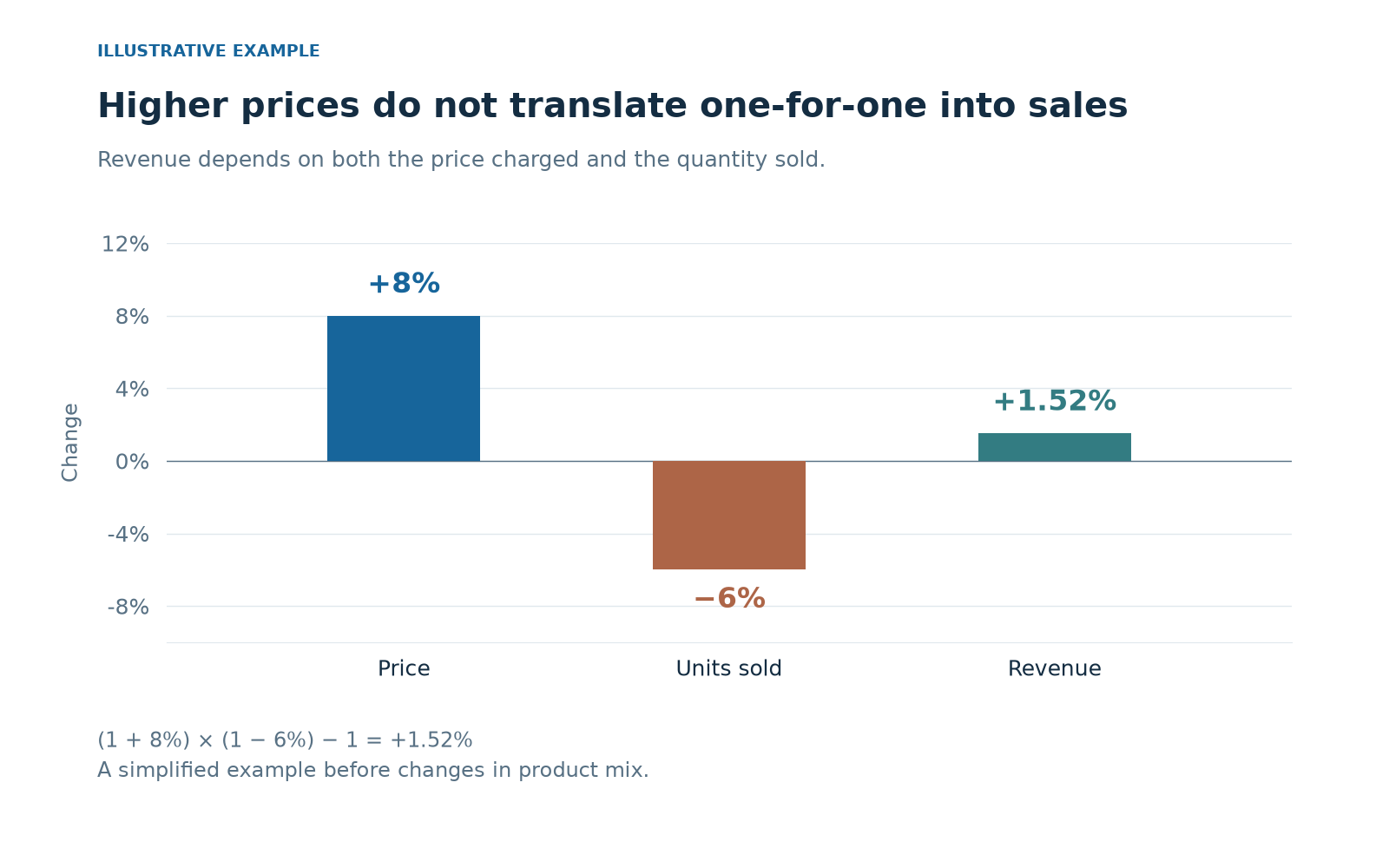
Consider a manufacturer that raises prices 8% while unit sales decline 6%. Before changes in product mix, revenue increases only about 1.5%, calculated as 1.08 multiplied by 0.94, minus one. If costs rise faster, the price increase may fail to protect profit. If customers later return, the initial volume decline may prove temporary.

What Limits a Company’s Ability to Raise Prices?
Substitutes, switching costs, brand relevance, and contract terms determine how far a business can go. A necessary product with few alternatives has a different bargaining position from a discretionary product that customers can postpone. Even a strong franchise can damage relationships by pushing prices beyond the value customers perceive.
Management explanations should be tested against retention, order frequency, discounts, and working capital. Revenue growth financed by longer payment terms may be less attractive than the headline suggests. Margin expansion accompanied by stronger cash conversion offers a different signal.
Look beyond the current quarter
Durable pricing power permits a business to recover costs while maintaining customer economics over time. It does not mean maximizing price every quarter. An equity assessment should therefore explain how price changes affect volume, loyalty, and reinvestment. The strongest business may be the one that leaves customers a reason to stay, even when it could charge more today.
Related research

ResearchEquity Strategy
A Low Price-to-Earnings Ratio Can Be Expensive
Valuation requires a view of earnings durability, not just a ranking of multiples.

ResearchEquity Strategy
Index Concentration Is a Portfolio Exposure, Not a Market Verdict
A rising index can depend on a narrow set of earnings drivers.

ResearchEquity Strategy
An Earnings Beat Is Only the Beginning
A practical framework for distinguishing operating progress from accounting and expectation effects.