
ResearchMarket Sentiment
Being Contrarian Requires More Than Disagreeing
- Report or archive date
- Archive placement June 11, 2026
- Reading time
- 1 min read

Summary
An unpopular view needs a mechanism, evidence, and the capacity to survive being early.
Contrarian investing is often presented as buying when others are fearful and selling when they are confident. That slogan omits the hardest question: whether the crowd is wrong. Pessimism can reflect a genuine deterioration in earnings or financing, and optimism can reflect real improvements in productivity and demand.
Identify the disagreement
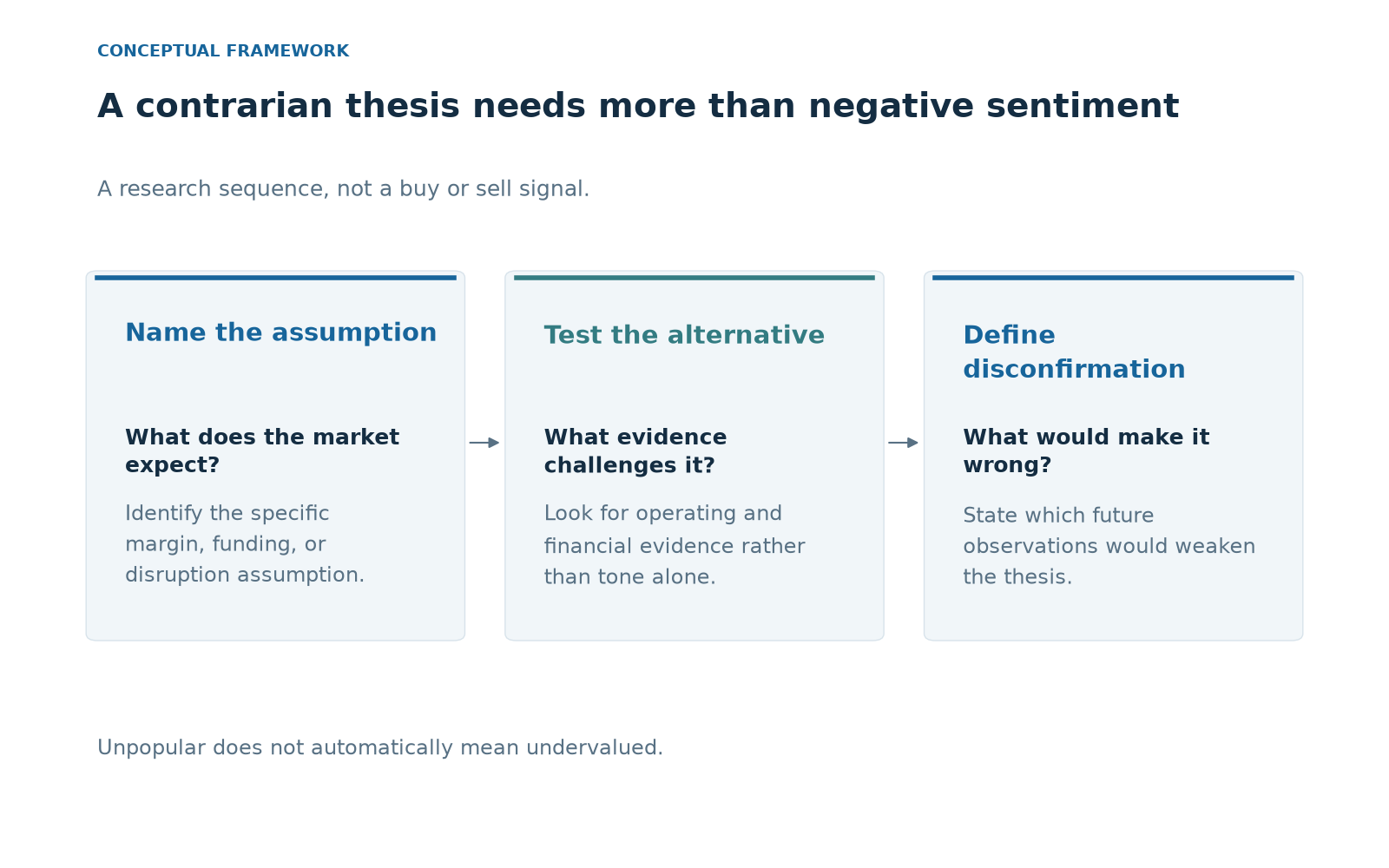
A useful contrarian thesis names the assumption it challenges. It might argue that margins can recover faster than expected, that financing risk is overstated, or that a temporary disruption has been treated as permanent. Simply observing negative headlines does not establish any of those propositions.
Sentiment indicators also measure different things. An options-based volatility index describes the pricing of near-term uncertainty, not a direct poll of investment conviction. Treating every high-volatility episode as a buying opportunity skips the fundamental analysis.
Require a path to resolution
Consider a company whose earnings have declined. A credible recovery case might depend on a completed restructuring, a manageable debt schedule, and evidence that customer demand is returning. A weaker case relies only on the stock having fallen far from its previous high.

The distinction is important because a low price can become lower if cash generation fails to stabilize. The previous price does not establish fair value, and the size of a decline does not create a natural floor.

Account for the cost of being early
Even a sound long-term view can fail operationally if the investor cannot tolerate interim losses or meet financing needs. Time horizon, position size, and liquidity determine whether the thesis can remain in place long enough to be tested.
A disciplined contrarian process records what the market appears to assume, why that assumption may be wrong, and what evidence would disprove the alternative view. It also specifies the risks that cannot be absorbed. Independence of thought is valuable when it improves the analysis. Disagreement by itself is neither evidence nor a source of return.
Related research

ResearchMarket Sentiment
A Crowded Position Is a Vulnerability, Not a Countdown
Positioning data can identify potential pressure without telling you when it will unwind.

ResearchMarket Sentiment
Market Breadth Adds Context to an Index Move
Participation can reveal the structure of a rally without proving its next direction.

ResearchMarket Sentiment
Confidence Surveys Describe Views, Not Committed Capital
What respondents say and what their portfolios can do are separate pieces of evidence.