
ResearchMarket Sentiment
Market Breadth Adds Context to an Index Move
- Report or archive date
- Archive placement August 6, 2026
- Reading time
- 1 min read

Summary
Participation can reveal the structure of a rally without proving its next direction.
An index measures the combined performance of its constituents under a particular weighting rule. Breadth measures ask how widely that performance is shared. The two perspectives can differ substantially, especially when a small group of large companies dominates the index.
Define the indicator first
Breadth can refer to advancing versus declining stocks, the proportion above a moving average, new highs and lows, or equal-weighted performance. These are different measurements. A claim that breadth improved should name the indicator, the universe, and the observation date.
The diversification principle is relevant here: exposure depends on the underlying holdings, not merely the number of securities in a label. Breadth adds information about participation, but it does not directly measure an investor’s complete portfolio risk.
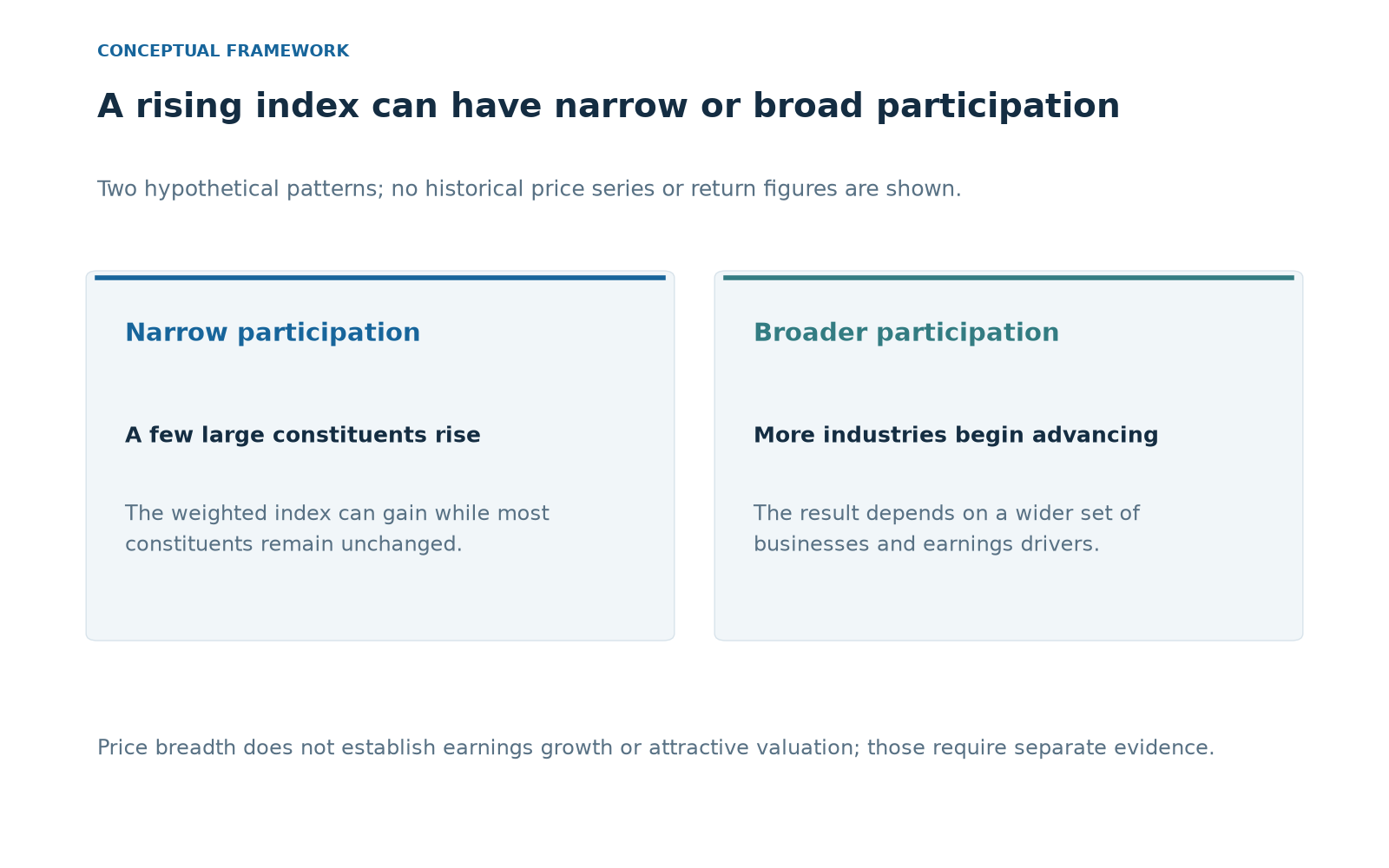
In an index, a few large constituents rise sharply while most stocks are unchanged. The index can gain despite narrow participation. If more industries later begin advancing, the rally becomes broader. That may reduce dependence on a single earnings theme, but it does not establish that prices are attractive.

Distinguish price breadth from earnings breadth
A larger share of stocks rising is not the same as a larger share of companies improving profits. Price moves can reflect changing discount rates, positioning, or expectations before earnings change. A strong analysis examines whether operating evidence supports the broader participation.
Seasonality, index membership changes, and sector composition can also influence breadth measures. Comparing different universes without adjusting the interpretation can create a false signal.

Use breadth to frame a risk
Narrow participation may make an index more sensitive to disappointment in its leaders. Broad participation may indicate that more business models are benefiting from the environment. Both are useful descriptions, not automatic timing rules.
The conclusion should explain what the participation pattern means for dependence on common drivers. It should then identify the valuation and earnings evidence needed to make an investment judgment. Breadth strengthens context; it does not replace analysis of price, cash flow, and risk.
Related research

ResearchMarket Sentiment
Being Contrarian Requires More Than Disagreeing
An unpopular view needs a mechanism, evidence, and the capacity to survive being early.

ResearchMarket Sentiment
When the News Feels Worse Than the Portfolio Evidence
Separating attention, uncertainty, and measurable exposure during a dense news cycle.

ResearchMarket Sentiment
A Crowded Position Is a Vulnerability, Not a Countdown
Positioning data can identify potential pressure without telling you when it will unwind.