
ResearchMarket Sentiment
Confidence Surveys Describe Views, Not Committed Capital
- Report or archive date
- Archive placement March 5, 2026
- Reading time
- 1 min read

Summary
What respondents say and what their portfolios can do are separate pieces of evidence.
A survey can reveal how a group feels about the economy or markets. It cannot automatically reveal how that group is invested, whether its members can act on their views, or how representative they are of the broader population. Those distinctions determine how much weight a sentiment reading deserves.
Inspect the measurement process
Before interpreting a survey, identify the sample, the question, the response period, and any changes in methodology. A survey of consumers is not a survey of portfolio managers. A question about economic conditions is not identical to a question about expected stock returns.

This distinction mirrors the broader need to separate measures with different purposes. The CFTC’s positioning framework, for example, reports categorized positions rather than directly measuring investor confidence. Neither a survey nor a position report should be treated as a complete substitute for the other.
Translate opinions cautiously
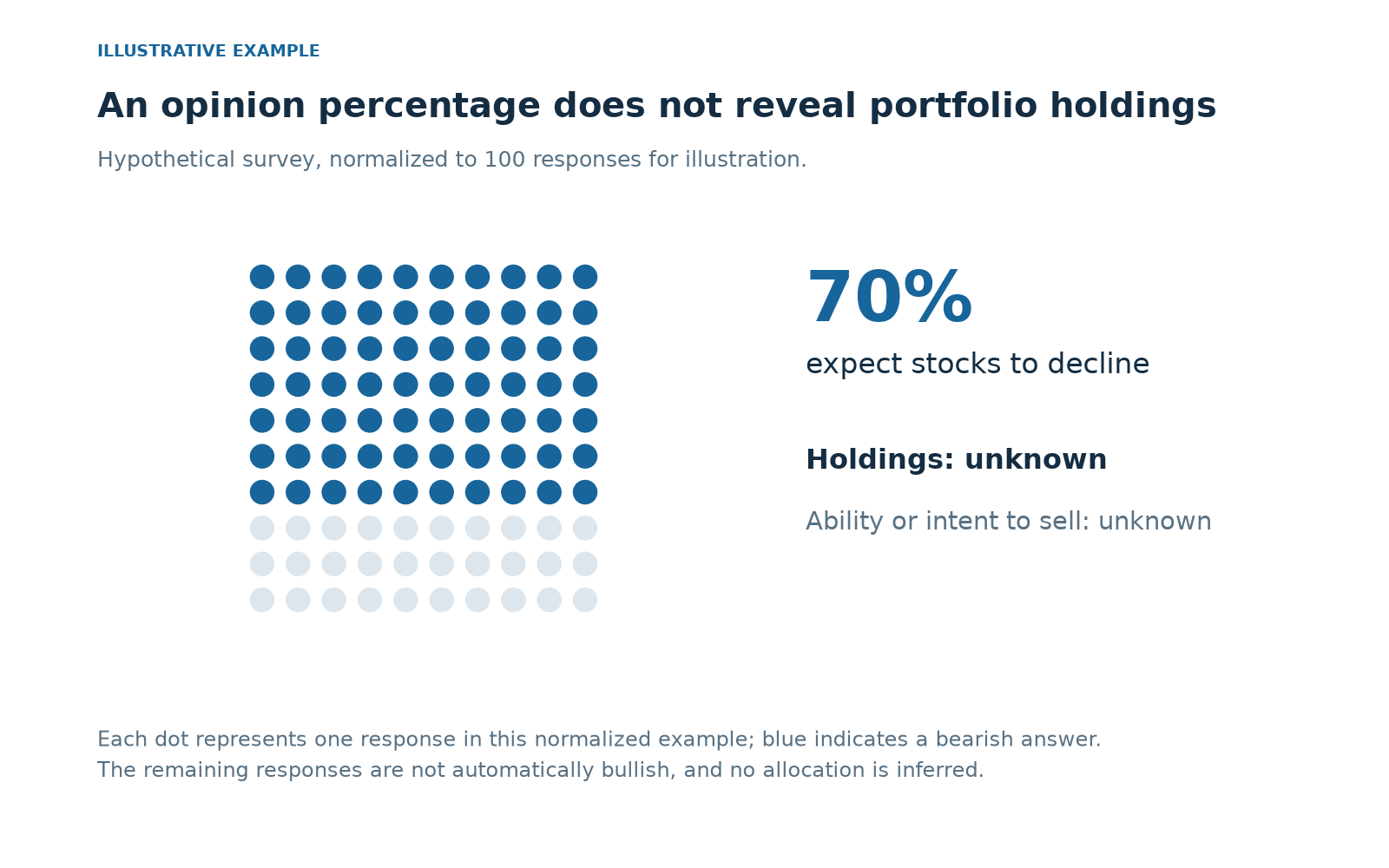
In a survey, 70% of respondents expect stocks to decline. Some may already hold little equity, some may be unable to change retirement allocations, and others may expect a short decline while retaining a favorable long-term view. The headline percentage does not identify the amount of potential selling.
Answers can also react to recent price moves. If a market falls sharply, respondents may become more pessimistic after the decline. That can make sentiment useful for describing the experience of a selloff while limiting its ability to forecast one.

Build a conditional interpretation
Extreme pessimism becomes more informative when combined with valuation, positioning, and signs that the underlying economic problem is stabilizing. Without those conditions, negative views may simply reflect continuing deterioration. The same logic applies to optimism: enthusiasm can accompany durable growth or excessive expectations.
A sound research note states what the survey actually asks and what additional evidence would be needed to connect the response to investment behavior. It can discuss the risk of crowded narratives without claiming that a particular percentage guarantees a reversal. Opinions are useful observations; the causal path from opinion to price still needs to be explained.
Related research

ResearchMarket Sentiment
What the VIX Can Tell You About Uncertainty
An options-based volatility measure is not a directional forecast for stocks.

ResearchMarket Sentiment
A Crowded Position Is a Vulnerability, Not a Countdown
Positioning data can identify potential pressure without telling you when it will unwind.

ResearchMarket Sentiment
Being Contrarian Requires More Than Disagreeing
An unpopular view needs a mechanism, evidence, and the capacity to survive being early.