
ResearchCross-Asset Allocation
Build Scenarios Around Mechanisms, Not Dramatic Labels
- Report or archive date
- Archive placement August 20, 2026
- Reading time
- 1 min read

Summary
A useful stress test explains how a shock reaches prices and cash flows.
Scenario analysis is most useful when it connects a plausible economic change to the portfolio’s actual exposures. Labels such as recession, inflation, or crisis are too broad on their own. Different versions of the same label can produce very different asset outcomes.
Specify the chain of effects
A demand slowdown might reduce sales, weaken pricing power, and lower expected policy rates. A supply disruption might raise costs while also weakening spending. A productivity improvement could support earnings while changing the level of real interest rates. Each scenario needs a coherent transmission mechanism.
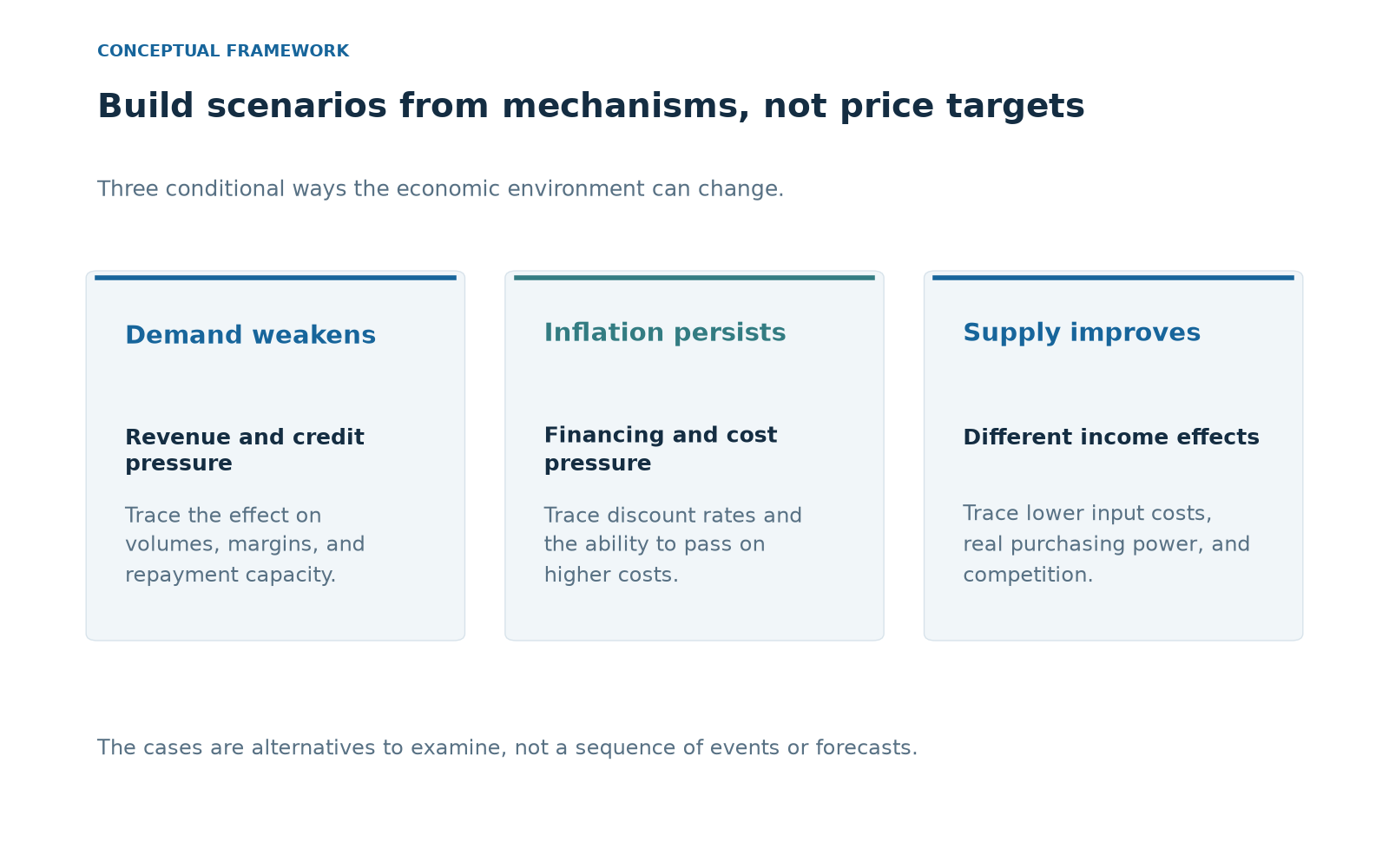
The IMF’s July outlook combined the adverse effects of conflict with support from technology investment. That contrast illustrates why a single positive or negative macro label can be inadequate. Multiple forces can operate simultaneously.
Keep assumptions visible
In a stress test, the analyst might assume lower revenue, narrower margins, and higher refinancing costs for a particular borrower. Those assumptions should be identified as inputs, not disguised as forecasts. The resulting loss estimate is conditional on them.

Probabilities require similar care. Assigning a precise percentage can create an appearance of knowledge that the evidence does not support. It may be more honest to compare several plausible cases and identify the exposures that remain vulnerable across them.
Include the operational consequences
A portfolio stress test should consider liquidity, collateral, and the ability to rebalance after losses. A strategy can appear acceptable on a terminal-return basis while failing because it cannot meet cash needs along the way.

The most useful output is often a ranking of vulnerabilities rather than a single expected return. Which assumption matters most? Which exposure produces the largest loss across several scenarios? Which protection fails when it is needed?
Scenario analysis does not eliminate uncertainty. It makes the uncertainty more actionable by showing how different conditions could affect the portfolio. A good scenario can be wrong about what happens next and still improve a decision by exposing a risk that would otherwise remain hidden.
Related research

ResearchCross-Asset Allocation
International Diversification Needs a Currency Policy
The asset decision and the exchange-rate decision should be evaluated separately.

ResearchCross-Asset Allocation
Drawdowns Change the Arithmetic of Recovery
Loss tolerance must account for both the path of returns and the cash taken out along the way.

ResearchCross-Asset Allocation
Liquidity Is the Ability to Meet a Need, Not Just to Place a Trade
A portfolio can contain tradable assets and still be poorly prepared for cash demands.