
ResearchCross-Asset Allocation
Drawdowns Change the Arithmetic of Recovery
- Report or archive date
- Archive placement September 17, 2026
- Reading time
- 1 min read

Summary
Loss tolerance must account for both the path of returns and the cash taken out along the way.
A percentage loss and an equal percentage gain do not cancel. After a decline, the next return applies to a smaller capital base. That simple arithmetic becomes especially important when an investor must withdraw money during a difficult period.
Start with the recovery calculation
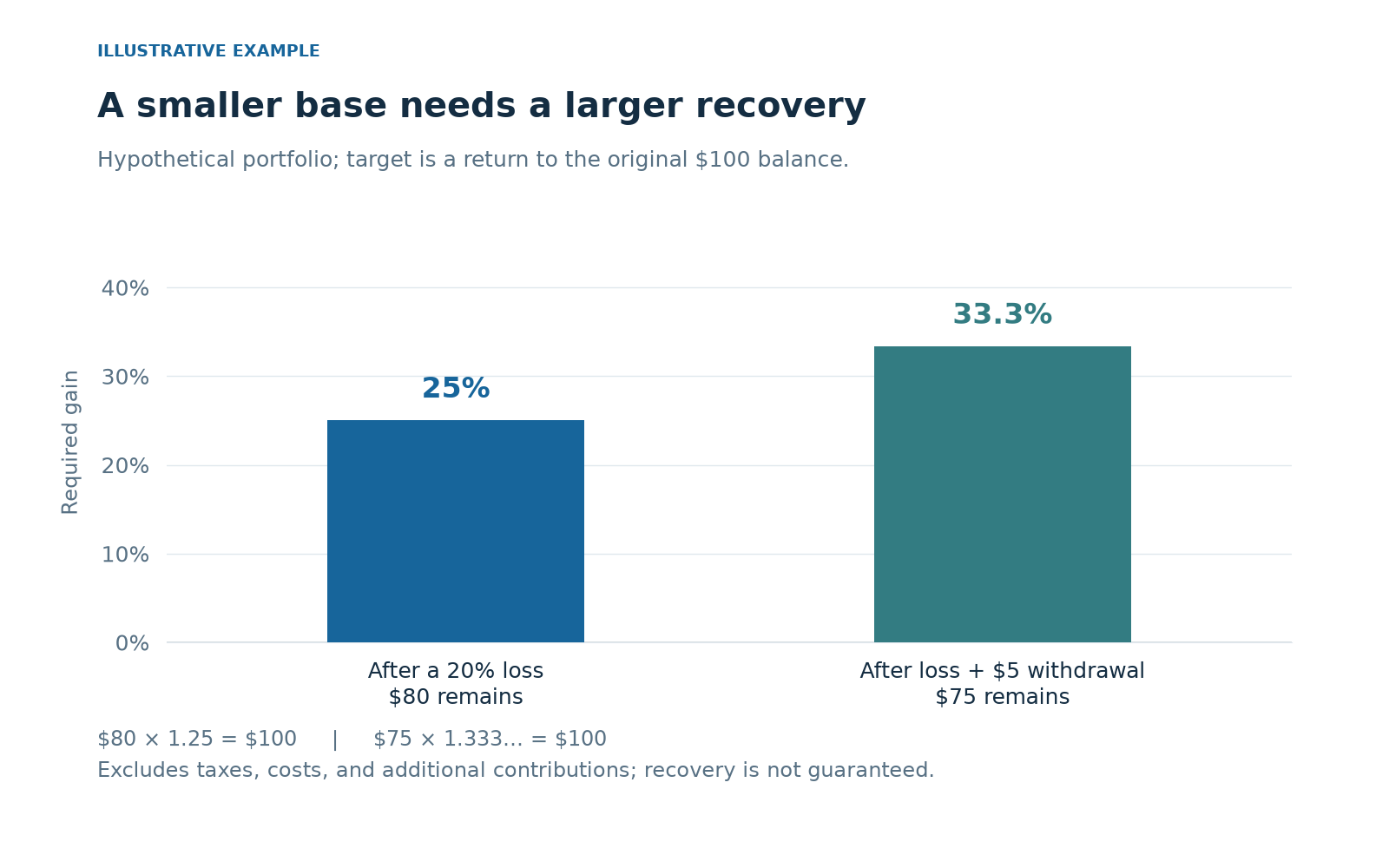
A portfolio falling from $100 to $80 has lost 20%. It needs a 25% gain to return to $100. If the investor also withdraws $5 at the low point, the remaining $75 needs a 33.3% gain to reach the original $100. These calculations ignore taxes, costs, and additional contributions, but they show why the path matters.
The SEC’s investor guidance connects investment risk with time horizon and goals. A long horizon can improve the ability to wait, but it does not remove scheduled spending or guarantee that recovery occurs before a particular deadline.
Willingness to Take Risk vs. Financial Capacity to Absorb Losses
An investor may feel comfortable with volatility yet lack the financial capacity to absorb a large loss. Another may have ample resources but find fluctuations difficult to tolerate. Both dimensions influence whether an allocation can be maintained.

For an institution, spending commitments, legal restrictions, and funding obligations can constrain the response. For an individual, employment income and emergency expenses may interact with market losses. A portfolio should be evaluated alongside those exposures rather than in isolation.

Design around the difficult period
Stress analysis can ask how much cash would be needed after a decline and which assets could supply it. It can also test whether a rebalance would still be feasible. A plan that requires additional risk-taking precisely when the investor is unable to act is fragile.
The objective is not to avoid every drawdown. It is to choose a level and structure of risk that the investor can survive without abandoning the underlying plan. Recovery arithmetic makes that discussion concrete and helps distinguish a tolerable mark-to-market decline from a loss that jeopardizes an actual obligation.
Related research

ResearchCross-Asset Allocation
Build Scenarios Around Mechanisms, Not Dramatic Labels
A useful stress test explains how a shock reaches prices and cash flows.

ResearchCross-Asset Allocation
Risk Budgets Reveal What Dollar Weights Hide
Equal allocations can make very unequal contributions to a portfolio’s uncertainty.

ResearchCross-Asset Allocation
International Diversification Needs a Currency Policy
The asset decision and the exchange-rate decision should be evaluated separately.