
ResearchFixed Income
Cash Has Reinvestment Risk Too
- Report or archive date
- Archive placement August 13, 2026
- Reading time
- 1 min read

Summary
A stable balance today does not lock in tomorrow’s income.
Short-term instruments can reduce sensitivity to changing interest rates, but their income resets as they mature. That creates reinvestment risk: the next investment may offer a lower return. A stable principal balance and a stable future income stream are different objectives.
Compare the horizons
Investor.gov identifies interest-rate, credit, and liquidity risks among the considerations for bond investors. Reinvestment adds a practical timing question. How long does the investor need the income, and for how long is the current rate actually secured?

Suppose a saver places funds in a three-month instrument yielding an annualized 4%. That does not lock in a 4% return for several years. After three months, the available rate may be higher or lower. A longer fixed-rate bond reduces uncertainty about contractual coupons while increasing sensitivity to interim market yields.
Neither choice is universally better. A near-term payment may favor liquidity and a matching maturity. A longer liability may justify a different structure. The comparison should be made over the same horizon and after relevant costs and taxes.
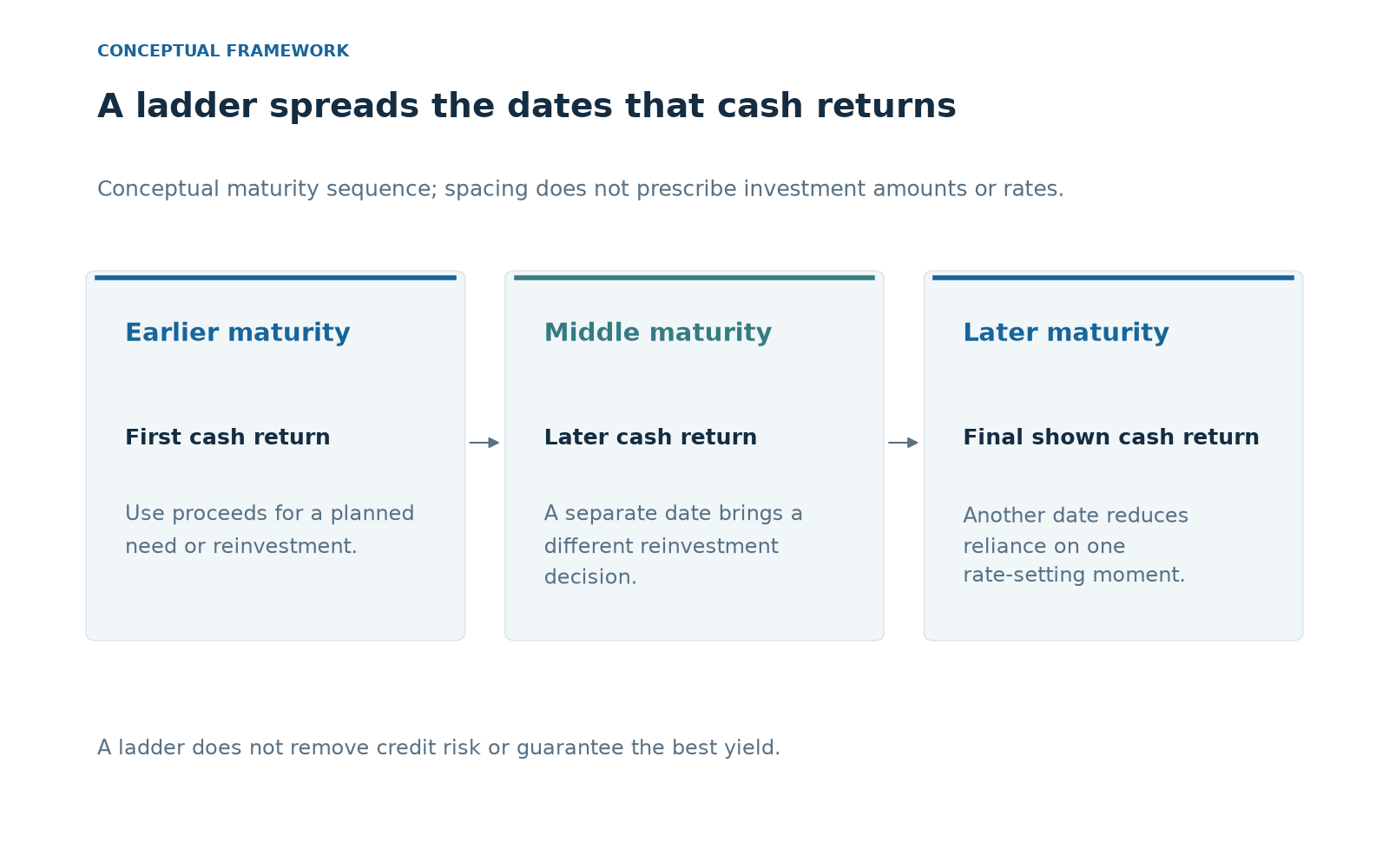
How a Maturity Ladder Staggers Reinvestment Dates
A maturity ladder spreads reinvestment dates over time. It can reduce dependence on one future rate-setting moment and organize cash availability. It does not eliminate credit risk, guarantee the best average yield, or protect every rung from market-price changes before maturity.

The structure also requires a plan for the proceeds. Automatically reinvesting every maturity may conflict with an approaching spending need. Selling a long rung early to meet an unexpected expense can reintroduce the price risk the ladder was intended to manage.
Evaluate real spending power
Nominal income is only one part of the outcome. Inflation can erode what the income buys, and taxes can change the amount available to spend. A research note should therefore distinguish liquidity, nominal principal stability, income certainty, and purchasing-power preservation. Cash can serve an important portfolio role without solving all four problems at once.
Related research

ResearchFixed Income
What TIPS Protect—and What They Leave Exposed
Inflation adjustment is a contractual feature, not a guarantee of a stable market value.

ResearchFixed Income
A Bond Fund’s Yield Is Not Its Promised Return
Understanding the difference between portfolio income, changing prices, and an investor’s holding period.

ResearchFixed Income
A Credit Spread Is Compensation, Not a Cushion You Can Spend Twice
Assessing the extra yield on corporate debt requires separating credit and interest-rate risks.