
ResearchMarket Sentiment
What the VIX Can Tell You About Uncertainty
- Report or archive date
- Archive placement February 12, 2026
- Reading time
- 1 min read

Summary
An options-based volatility measure is not a directional forecast for stocks.
The VIX is often described as a fear gauge, but that shorthand can encourage overinterpretation. It is a market-based measure derived from option prices. It does not interview investors, identify their motives, or predict whether the stock market will rise or fall next week.
The VIX’s 30-Day Volatility Horizon and Annualized Scale
Cboe’s methodology constructs an annualized measure of expected S&P 500 volatility over a constant 30-day horizon using option prices. The annualization convention does not mean the number forecasts a full year of returns. The underlying horizon and the quoted scale are different.
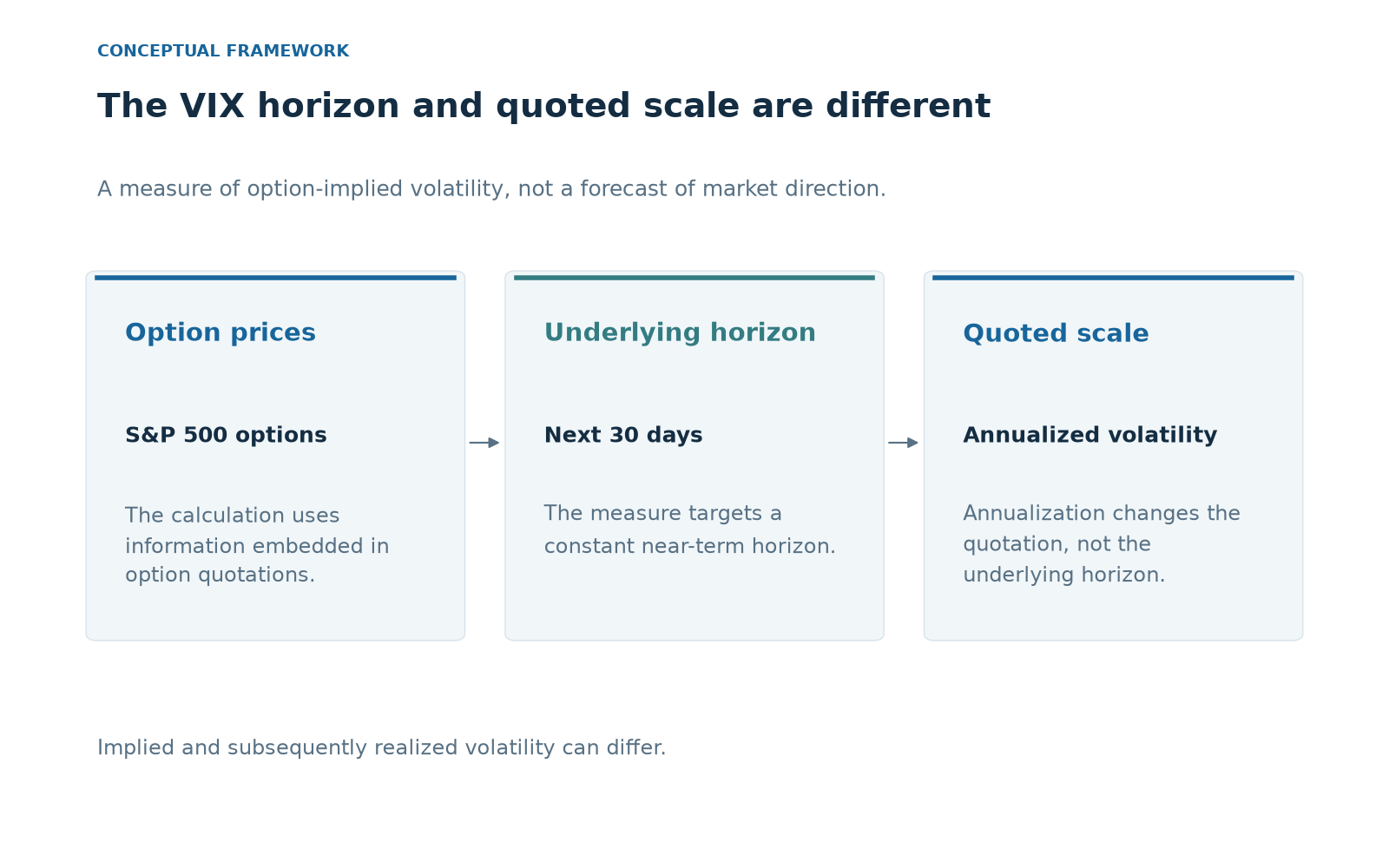
Options embed the cost of protection and compensation for risk as well as expectations about future movement. Implied volatility can therefore differ from the volatility that is subsequently realized. That difference is not automatically a calculation error.

Avoid the timing shortcut
A high reading may occur during a sharp selloff, but it does not establish that the selloff is finished. Uncertainty can remain elevated, and losses can continue. A low reading may coexist with concentrated risks that have not yet produced large daily moves.

Consider two situations with similar implied volatility. One surrounds a scheduled policy decision whose uncertainty may resolve quickly. The other reflects a continuing funding problem with no clear resolution date. The same index level can sit inside very different risk environments.

Combine evidence with care
A useful sentiment assessment can compare implied and realized volatility, inspect the market’s breadth, and examine credit conditions. It should also state the dates and instruments used. A volatility measure for one equity index is not a complete measure of risk across bonds, currencies, or an individual portfolio.
The practical value of the VIX is that it helps describe how the options market is pricing near-term uncertainty. It becomes less useful when converted into a universal buy or sell rule. The research question is what kind of uncertainty is being priced and whether the portfolio can tolerate the associated range of outcomes.
Related research

ResearchMarket Sentiment
Confidence Surveys Describe Views, Not Committed Capital
What respondents say and what their portfolios can do are separate pieces of evidence.

ResearchMarket Sentiment
A Crowded Position Is a Vulnerability, Not a Countdown
Positioning data can identify potential pressure without telling you when it will unwind.

ResearchMarket Sentiment
Being Contrarian Requires More Than Disagreeing
An unpopular view needs a mechanism, evidence, and the capacity to survive being early.