
ResearchCross-Asset Allocation
Risk Budgets Reveal What Dollar Weights Hide
- Report or archive date
- Archive placement November 11, 2026
- Reading time
- 1 min read

Summary
Equal allocations can make very unequal contributions to a portfolio’s uncertainty.
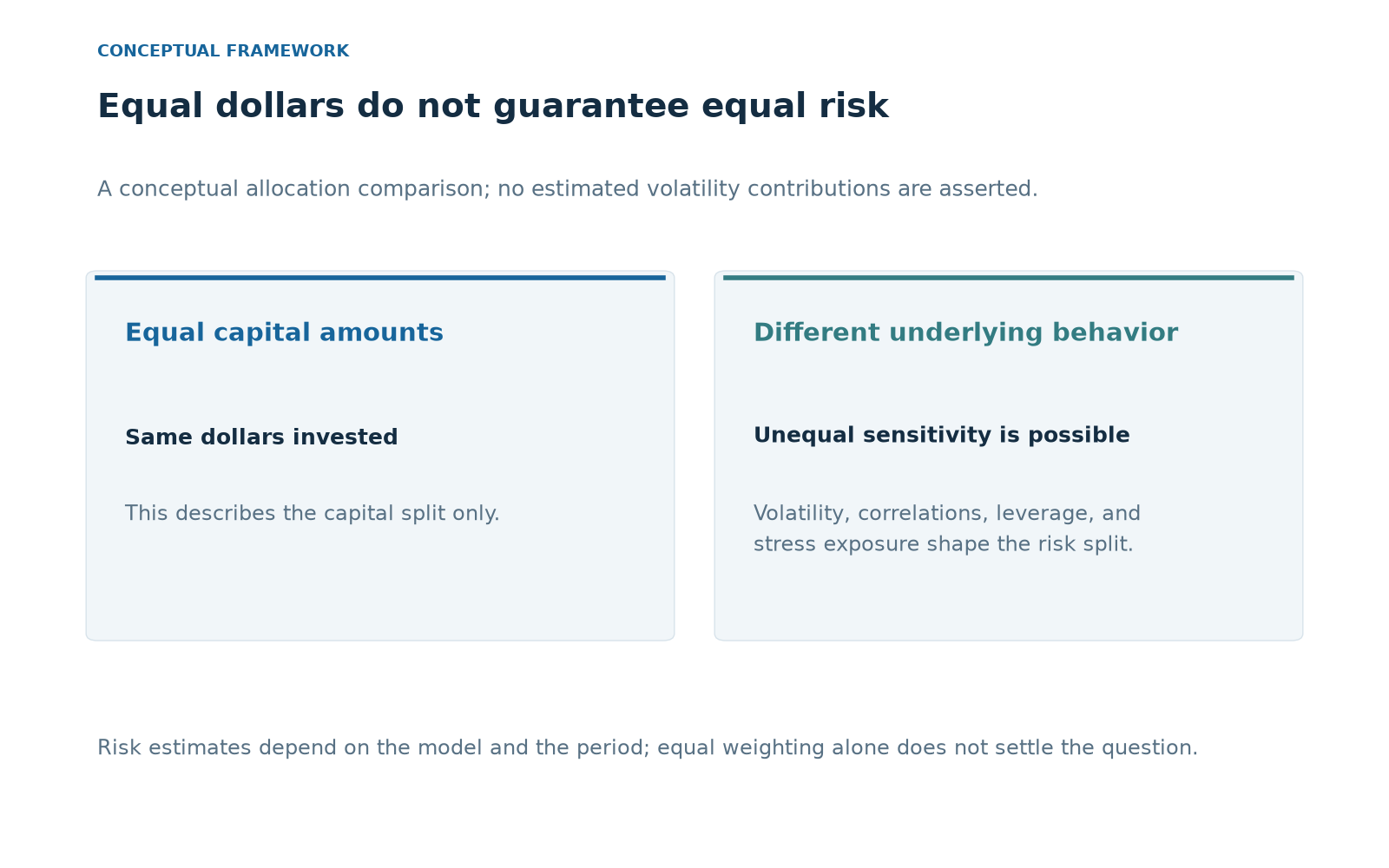
A portfolio split evenly between two assets is not necessarily balanced in risk. One holding may be much more volatile, more leveraged, or more sensitive to a common shock. Dollar weights describe capital allocation; they do not fully describe the distribution of uncertainty.
Portfolio Weights vs. Contributions to Portfolio Risk
Imagine a portfolio with half its capital in short-term government instruments and half in volatile equities. Most day-to-day price variability may come from the equity allocation. The equal dollar split should not be described as equal risk.
Diversification depends on how holdings interact as well as on their individual characteristics. A small position that moves closely with the portfolio’s dominant risk can add more vulnerability than its size suggests. Another position may reduce some variability while introducing a different tail risk.

Treat estimates as conditional
Risk models use assumptions about volatility and correlation. Those inputs can change, particularly during stress. A model may also omit liquidity, legal restrictions, or the possibility of a discontinuous price move. An estimated contribution to variance is useful, but it is not a complete measure of possible loss.

Risk-balancing approaches can create additional questions if they use borrowing or derivatives to increase exposure to lower-volatility assets. The apparent balance then depends on financing costs, collateral, and the behavior of correlations. A low historical volatility estimate does not guarantee a low-risk leveraged position.

Connect the budget to a decision
A practical risk budget identifies which exposures are intentional, how large their consequences could be, and what would trigger a review. It can combine statistical measures with scenario losses and liquidity needs. No single measure should carry the entire judgment.
The purpose is to make concentration visible before it becomes a problem. When risk contributions and dollar weights differ, the investor can decide whether the imbalance is acceptable. A defensible allocation is not necessarily symmetrical. It is one whose largest sources of uncertainty are understood and consistent with the portfolio’s obligations.
Related research

ResearchCross-Asset Allocation
Drawdowns Change the Arithmetic of Recovery
Loss tolerance must account for both the path of returns and the cash taken out along the way.

ResearchCross-Asset Allocation
Build Scenarios Around Mechanisms, Not Dramatic Labels
A useful stress test explains how a shock reaches prices and cash flows.

ResearchCross-Asset Allocation
International Diversification Needs a Currency Policy
The asset decision and the exchange-rate decision should be evaluated separately.