
ResearchCross-Asset Allocation
Give Every Asset a Job Before Giving It a Weight
- Report or archive date
- Archive placement January 15, 2026
- Reading time
- 1 min read

Summary
Portfolio design starts with liabilities and risk capacity, not a list of attractive markets.
An allocation is easier to evaluate when each holding has a defined purpose. Growth assets, spending reserves, inflation-sensitive instruments, and diversifiers solve different problems. Without that distinction, a portfolio can accumulate appealing investments while leaving its most important needs uncovered.
Begin with the obligations
Time horizon and tolerance for losses are central to asset allocation. A payment due in six months should not be analyzed as though it were an open-ended retirement objective. The amount, timing, and flexibility of the liability determine how much uncertainty can be accepted.
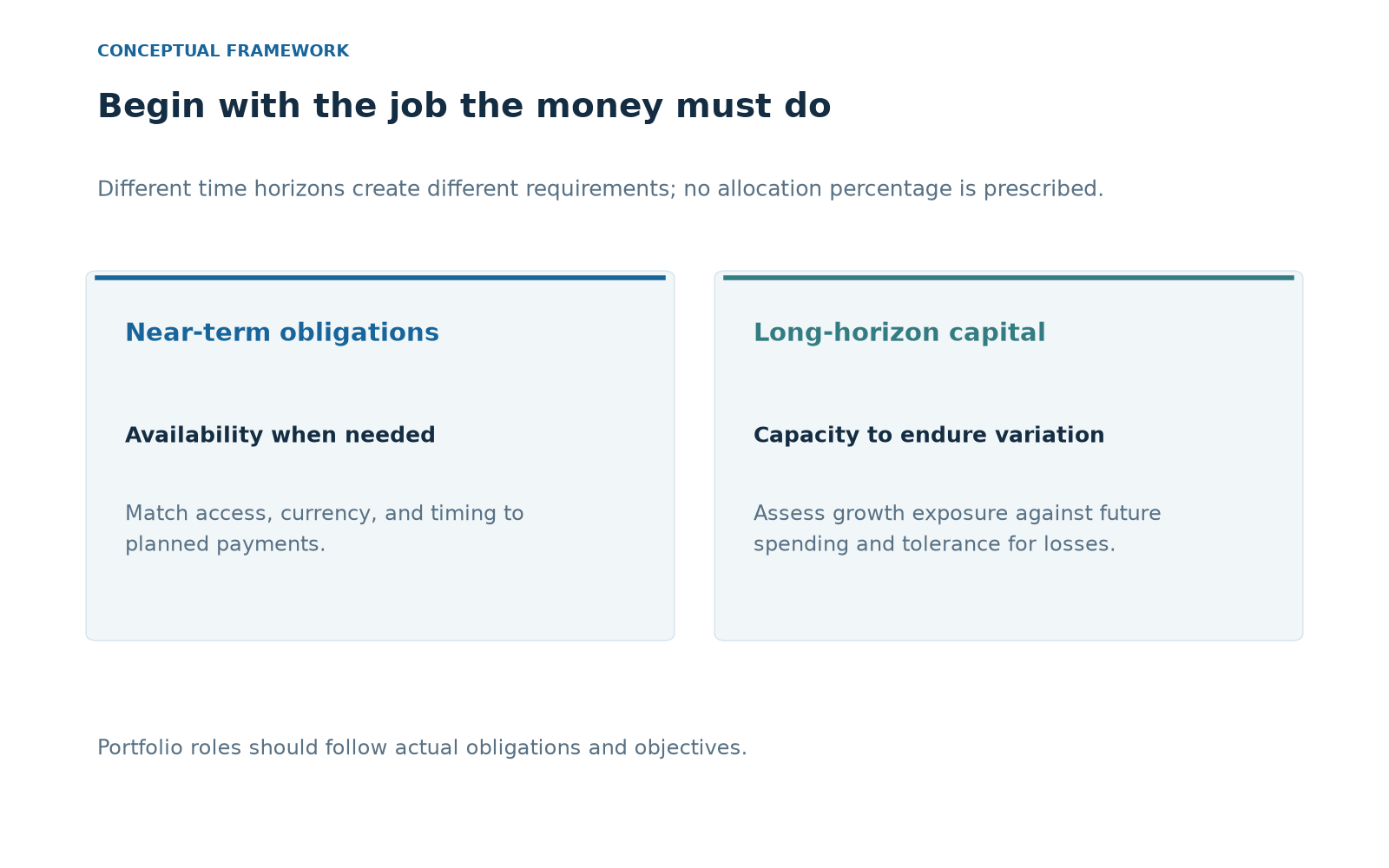
Consider an organization with operating expenses due this year and a long-term reserve. Combining both into a single aggressive portfolio may create pressure to sell after a decline. Separating near-term liquidity from long-horizon capital makes the trade-off more visible, even if the organization ultimately manages them within one account.
Define the contribution
An equity allocation might seek long-term participation in business growth. High-quality fixed income might organize future nominal cash flows or provide sensitivity to falling yields. Cash might support immediate spending and flexibility. Inflation-linked bonds might address part of a future purchasing-power obligation.

These roles are conditional. Bonds can lose value when yields rise. Equities can disappoint for long periods. Cash income can reset lower. Naming an intended role does not guarantee that an asset will perform it in every environment.
Evaluate the combination
The useful question is what happens when several assumptions fail together. A portfolio described as diversified may still depend heavily on low inflation, easy refinancing, or one industry’s earnings. Stress testing those shared drivers can reveal a concentration that asset-class labels miss.

Implementation then matters: costs, taxes, liquidity, and complexity can change the practical outcome. An allocation that looks elegant but cannot be maintained through a difficult period is not robust.
The research conclusion should explain the purpose of each major exposure and the conditions under which it could disappoint. Weights become more defensible when they follow that reasoning rather than precede it.
Related research

ResearchCross-Asset Allocation
Diversification Depends on the Shock
Assets that offset each other in one environment can decline together in another.

ResearchCross-Asset Allocation
Rebalancing Is a Risk Decision Before It Is a Return Decision
A disciplined process restores intended exposure without pretending to forecast market turning points.

ResearchCross-Asset Allocation
Liquidity Is the Ability to Meet a Need, Not Just to Place a Trade
A portfolio can contain tradable assets and still be poorly prepared for cash demands.