
ResearchCross-Asset Allocation
Rebalancing Is a Risk Decision Before It Is a Return Decision
- Report or archive date
- Archive placement April 9, 2026
- Reading time
- 1 min read

Summary
A disciplined process restores intended exposure without pretending to forecast market turning points.
Market movements change portfolio weights even when no trades occur. A successful asset can gradually become a larger source of risk, while a declining asset becomes smaller. Rebalancing addresses that drift by reconnecting the portfolio to its intended allocation.
Establish the purpose
Investor.gov describes rebalancing as restoring an allocation that has moved away from its target. That purpose is different from selling because a market is about to peak. A rebalance can be sensible even when the asset being reduced continues to rise afterward.
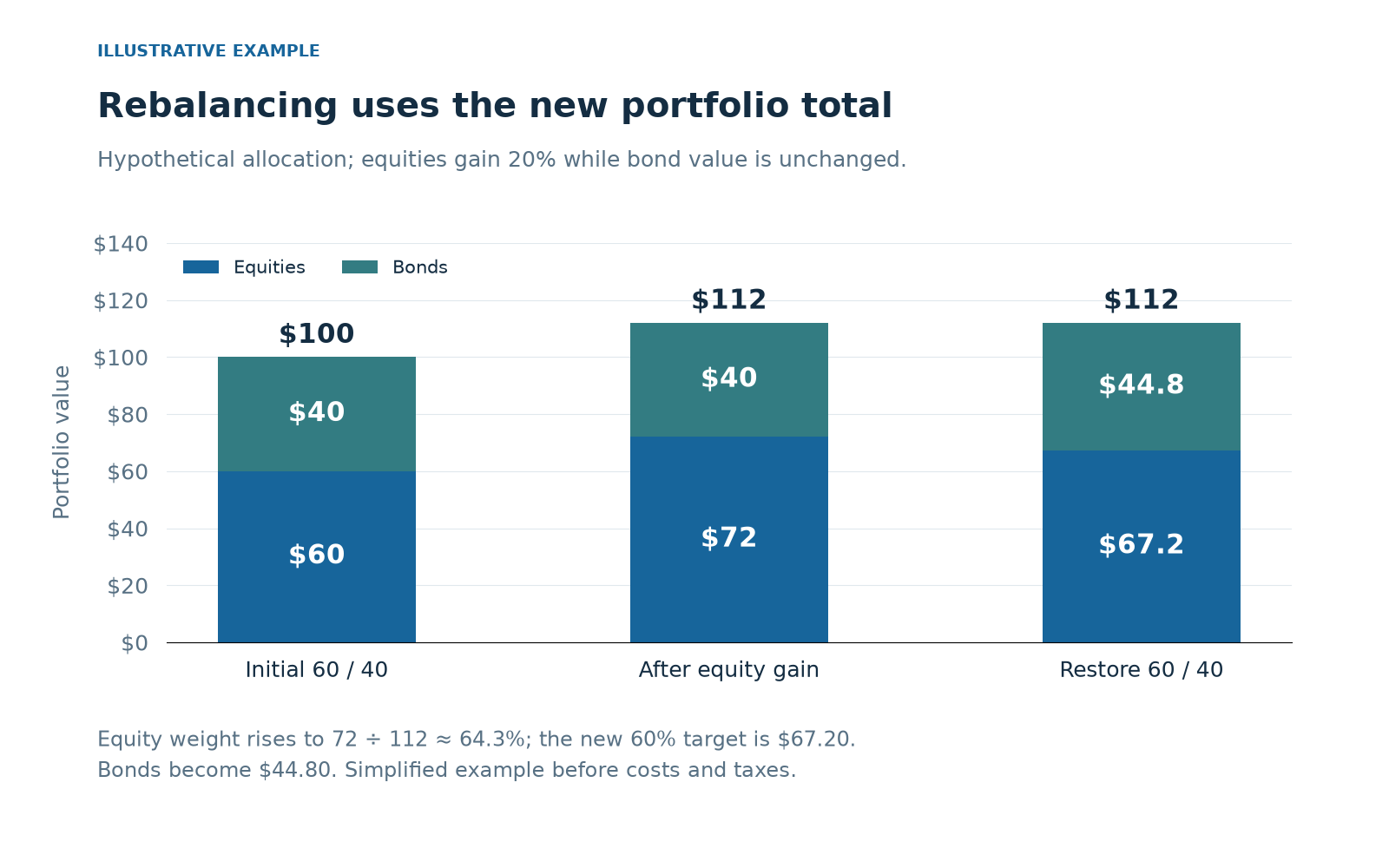
Suppose a portfolio begins with $60 in equities and $40 in bonds. Equities rise 20% while bonds are unchanged. The portfolio becomes $72 in equities and $40 in bonds, so the equity weight increases to about 64.3%. Restoring a 60% weight means reducing exposure relative to the new total, not returning to the original dollar amounts.
Choose a rule that can be followed
A calendar approach creates regular review points. A threshold approach responds when weights move beyond predefined bands. Either can be reasonable, but the process should account for transaction costs, taxes, and the size of the deviation.

New contributions or withdrawals can sometimes reduce drift without selling existing holdings. The practical method depends on cash needs and account structure. A rule that ignores those constraints may generate unnecessary turnover.

Portfolio-Weight Drift vs. a Change in Investment Objectives
If the investor’s liabilities, horizon, or capacity for loss have changed, restoring the old allocation may be inappropriate. That is a policy review, not routine rebalancing. The distinction prevents a mechanical process from overriding a meaningful change in circumstances.
Rebalancing can also underperform a continuously rising asset over a particular period. Its justification should not rely on a promise of higher returns. The defensible objective is to keep risk near a deliberate level. A written process is useful because it makes the decision easier to explain when market momentum or emotion favors doing something else.
Related research

ResearchCross-Asset Allocation
Diversification Depends on the Shock
Assets that offset each other in one environment can decline together in another.

ResearchCross-Asset Allocation
Liquidity Is the Ability to Meet a Need, Not Just to Place a Trade
A portfolio can contain tradable assets and still be poorly prepared for cash demands.

ResearchCross-Asset Allocation
Give Every Asset a Job Before Giving It a Weight
Portfolio design starts with liabilities and risk capacity, not a list of attractive markets.